

Exit planning is not simply about finding a buyer and agreeing a price. For UK tech and fintech founders, it is a multi-layered financial and strategic process that can span years, involve complex tax structures, and ultimately determine how much you actually walk away with. Many founders assume lawyers or corporate finance advisers drive the exit. The reality is that your accountant is often the most important person in the room, and the earlier you bring them in, the better your outcome. This article explains exactly how expert accounting advice shapes investor confidence, compliance, and the final number on your term sheet.
Table of Contents
- What is exit planning for UK tech and fintech startups?
- Key roles accountants play throughout the exit process
- Maximising value: Tax structures, reliefs and SaaS metrics
- Risks of exit without expert accounting advice
- Why exit planning for tech founders needs accountants at the centre
- Connect with expert accountants for seamless exits
- Frequently asked questions
Key Takeaways
PointDetailsEarly accountant involvementEngaging accountants early maximises your startup’s value and exit readiness.Boost value with structuresTax reliefs and optimal SaaS metrics can mean significantly higher sale multiples for founders.Avoid costly pitfallsExpert accounting support prevents failed deals, undervaluation and post-sale issues.Tech expertise mattersAccountants with startup and SaaS sector knowledge secure better outcomes during transitions.
What is exit planning for UK tech and fintech startups?
Exit planning is the process of preparing your business for a transition of ownership or control. For tech and fintech founders, that could mean a trade sale or merger and acquisition (M&A), a management buyout (MBO), a stock market listing via an initial public offering (IPO), or in some cases, an orderly wind-down. Each route carries its own financial, legal, and tax implications, and none of them should be approached without a clear financial strategy in place.
The biggest mistake founders make is treating exit planning as a late-stage task. By the time a buyer is interested, it is often too late to fix messy accounts, restructure share options, or claim reliefs you were always entitled to. Ideally, exit planning should begin 18 to 24 months before you anticipate any transaction. That window gives your accountant time to clean up your financial history, optimise your structure, and present a business that commands maximum value.
For UK tech and fintech companies specifically, the stakes are high. Buyers and investors in this sector scrutinise SaaS metrics (software-as-a-service performance indicators such as annual recurring revenue, churn rate, and customer lifetime value) alongside traditional financial statements. They want to see financial statements for seed funding that are clean, consistent, and investor-ready. Regulatory compliance, particularly around financial conduct and data handling, also adds a layer of complexity that generalist accountants often miss.
Here are the main exit routes available to UK tech and fintech founders:
- Trade sale or M&A: Selling to a strategic buyer or competitor
- Management buyout (MBO): Existing management team acquires the business
- Private equity buyout: A PE firm acquires a controlling stake
- IPO: Listing on a public exchange such as the London Stock Exchange
- Secondary sale: Selling shares to another investor without a full exit
- Wind-down or dissolution: Orderly closure with asset distribution
Valuations in this sector reflect the premium buyers place on scalability. Tech startups can command 8 to 12 times EBITDA multiples for scalable technology businesses, which is significantly higher than traditional sectors. That premium only materialises if your financials tell the right story, and that is precisely where your accountant earns their fee.
Key roles accountants play throughout the exit process
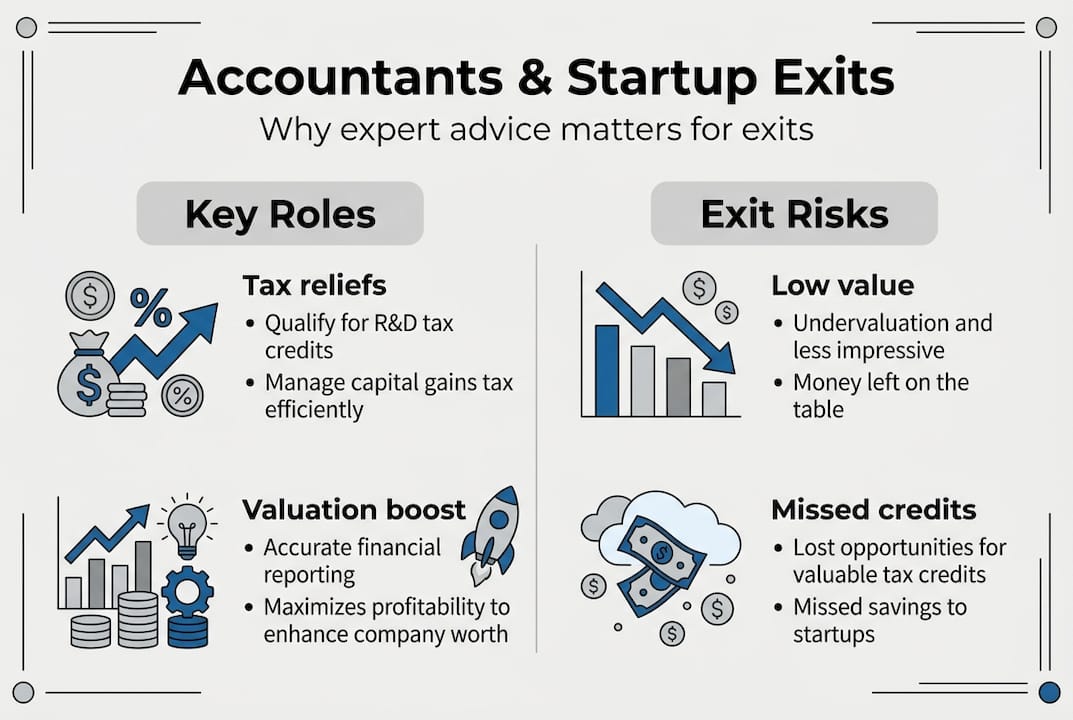
Accountants are not just number-checkers. In the context of a startup exit, they are strategic architects who shape every stage of the transaction. Their involvement typically spans four phases: pre-exit preparation, due diligence support, deal structuring, and post-exit compliance.
Here is what that looks like in practice:
- Pre-exit preparation: Cleaning up historical accounts, resolving any HMRC compliance gaps, restructuring share option schemes such as EMI (Enterprise Management Incentive), and ensuring your books reflect the true value of the business.
- Due diligence support: Preparing a data room, responding to buyer queries, and presenting financial information in a format that builds buyer confidence rather than raising red flags.
- Deal structuring: Advising on the most tax-efficient way to structure the transaction, whether that involves earn-outs, deferred consideration, or asset versus share sales.
- Post-exit compliance: Managing the tax implications of the sale proceeds, advising on Business Asset Disposal Relief (formerly Entrepreneurs’ Relief), and ensuring founders meet all reporting obligations.
One of the most impactful contributions accountants make is ensuring that government-backed schemes are correctly in place. Accountants structure SEIS, EIS, EMI and R&D tax credits to create investor-ready financials that withstand scrutiny. Proper tax planning for UK startups is not an administrative task; it is a direct lever on your exit valuation.
Understanding SEIS/EIS relief explained is particularly important because buyers and investors will examine whether early-stage funding was structured correctly. Errors here can invalidate relief claims and create unexpected liabilities that derail deals at the final stage.
“The founders who achieve the best exit outcomes are those who treat their accountant as a strategic partner from day one, not a compliance function they call in at the end.”
Pro Tip: Do not wait for a buyer to start getting your financials exit-ready. Begin the process at least two years out, and use that time to build the financial narrative that commands a premium valuation.
Maximising value: Tax structures, reliefs and SaaS metrics
For UK tech and fintech founders, the gap between a good exit and a great one often comes down to how well your accountant has engineered the financial picture. There are several specific tools available that, when used correctly, can meaningfully increase your exit multiple.

Accountants maximise investor-ready financials using SEIS, EIS, EMI share option schemes, R&D tax credits for startups, and SaaS performance metrics. Each of these has a direct bearing on how buyers assess risk and growth potential.
Here is a summary of the value impact different structures can provide:
Structure or reliefPrimary benefitImpact on exitSEIS/EIS schemesInvestor tax relief on early fundingAttracts quality investors, validates cap tableEMI share optionsTax-efficient employee equityRetains talent, reduces liability at exitR&D tax creditsCash back on qualifying innovation spendImproves cash position and EBITDAClean SaaS metricsDemonstrates predictable revenueSupports higher revenue multiplesAudited accountsReduces buyer due diligence riskSpeeds up deal timeline
SaaS metrics deserve particular attention. Buyers of tech businesses do not just look at profit. They assess annual recurring revenue (ARR), monthly churn rate, customer acquisition cost (CAC), and lifetime value (LTV). These numbers tell the story of your business’s predictability and scalability. If your financial systems are not capturing these metrics cleanly, you are leaving money on the table.
What buyers and investors look for in financial statements:
- Consistent revenue recognition policies
- Clear separation of recurring and one-off income
- Low and stable churn rates
- Strong gross margins (typically 70%+ for SaaS)
- Evidence of scalable cost structures
- Properly documented SEIS/EIS investment guide compliance
Pro Tip: Set up cloud accounting systems such as Xero from day one, configured to capture the SaaS metrics buyers care about. Retrofitting this data at exit stage is costly and unconvincing to sophisticated buyers.
Risks of exit without expert accounting advice
Skipping specialist accounting support during an exit is one of the most expensive decisions a founder can make. The risks are not abstract. They show up as failed deals, reduced valuations, and unexpected tax bills that arrive months after you thought the process was finished.
ScenarioWith expert accountantsWithout expert accountantsDue diligenceClean data room, fast responsesGaps trigger price reductions or deal collapseTax structuringReliefs claimed, efficient deal structureMissed reliefs, higher CGT exposureSaaS metricsClearly presented, buyer-readyInconsistent data raises buyer doubtHMRC complianceFully up to dateHistoric issues resurface, create liabilityValuationSupported by robust financialsBuyer drives down price on uncertainty
Missing out on strategic tax reliefs or presenting misaligned financials can dramatically reduce your final valuation. This is not a theoretical risk. It is something we see regularly when founders approach us after a deal has already fallen through.
The most common pitfalls include:
- Failing to claim R&D tax credits on qualifying expenditure before the exit
- Poorly documented EMI schemes that create unexpected employee tax liabilities
- Inconsistent revenue recognition that confuses buyers during due diligence
- Missing HMRC deadlines that create compliance flags mid-transaction
- No clear audit trail for SEIS/EIS investments, invalidating investor relief claims
“We have seen deals collapse at heads of terms stage because the financial records simply could not withstand scrutiny. The fix would have taken three months if started earlier; at deal stage, there is no time.”
The solution is straightforward: engage a specialist accountant early, follow a structured tax planning checklist for startups, and treat financial housekeeping as an ongoing discipline rather than a pre-exit sprint.
Why exit planning for tech founders needs accountants at the centre
Conventional wisdom places lawyers and corporate finance advisers at the heart of any exit. They are important, no question. But the founders who achieve the strongest outcomes are those who put their accountant at the centre of the process from the very beginning, not just at signing stage.
Here is why that matters. Lawyers negotiate terms. Corporate finance advisers find buyers. But accountants are the ones who determine whether the business is actually worth what you think it is, and whether the deal structure leaves you better or worse off after tax. They spot valuation enhancers that others overlook, such as unclaimed R&D credits or improperly structured share schemes that could be corrected. They also identify red flags before buyers do.
The smartest founders we work with treat SME tax compliance tips and financial strategy as inseparable. A collaborative approach involving accountants, lawyers, and advisers is ideal, but if you leave accountants out or bring them in too late, you risk costly oversights that no amount of legal skill can fix after the fact.
Connect with expert accountants for seamless exits
If you are a UK tech or fintech founder thinking about an exit in the next two to three years, the best time to act is now. The financial groundwork you lay today directly determines the valuation you achieve tomorrow.

At Price & Accountants, we specialise in supporting tech and fintech startups through every stage of their financial journey, from early-stage funding to exit. Our team can help you claim R&D tax credits, structure your cap table, and build the investor-ready financials that command premium multiples. Explore our company accounting services or speak to us about strategic advisory and tax planning tailored specifically to your exit goals.
Frequently asked questions
When should UK startup founders involve accountants in exit planning?
Founders should engage accountants at least 12 to 24 months before a potential exit. Early accountant involvement ensures investor-ready financials that support higher exit multiples.
How do accountants boost valuation in a tech startup exit?
They optimise SEIS, EIS, and EMI structures, strengthen SaaS metrics, and secure R&D tax credits. Accountants structuring these reliefs can directly increase the multiples buyers are willing to pay.
What is the risk of not using an accountant in exit planning?
Startups risk lower valuations, failed deals, or unexpected tax liabilities from missed reliefs and poor records. Misaligned financials can reduce valuations significantly and undermine buyer confidence.
Why are SaaS metrics important in exit planning?
Buyers assess recurring revenue, churn, and lifetime value to determine price and growth potential. SaaS metrics like ARR drive higher exit multiples for tech startups when presented clearly and consistently.
Recommended
- Role of accountants for UK tech startups in 2026 - Price & Accountants
- Why startups need accountants for UK tech founders - Price & Accountants
- Accountants’ role post investment for UK tech startups - Price & Accountants
- Essential accounting tips for UK tech startups scaling to Series A - Price & Accountants
- Role of accountants in Switzerland: 2026 guide