

TL;DR:
- Accounting rules are rapidly evolving, with AI enabling higher revenue per employee and freeing time for strategic advisory.
- Effective implementation requires process clarity, governance frameworks, and real-time data integration to achieve faster closes and maintain compliance.
The rules of accounting are being rewritten fast. Firms using AI now report 37% higher revenue per employee and save two or more hours every week, redirecting that capacity towards advisory work. For business leaders and entrepreneurs, the accounting trends in 2026 are not background noise. They are a direct opportunity to reduce costs, sharpen financial decision-making, and gain ground on competitors who are still managing their close cycles on spreadsheets and quarterly gut instinct.
Table of Contents
- Key takeaways
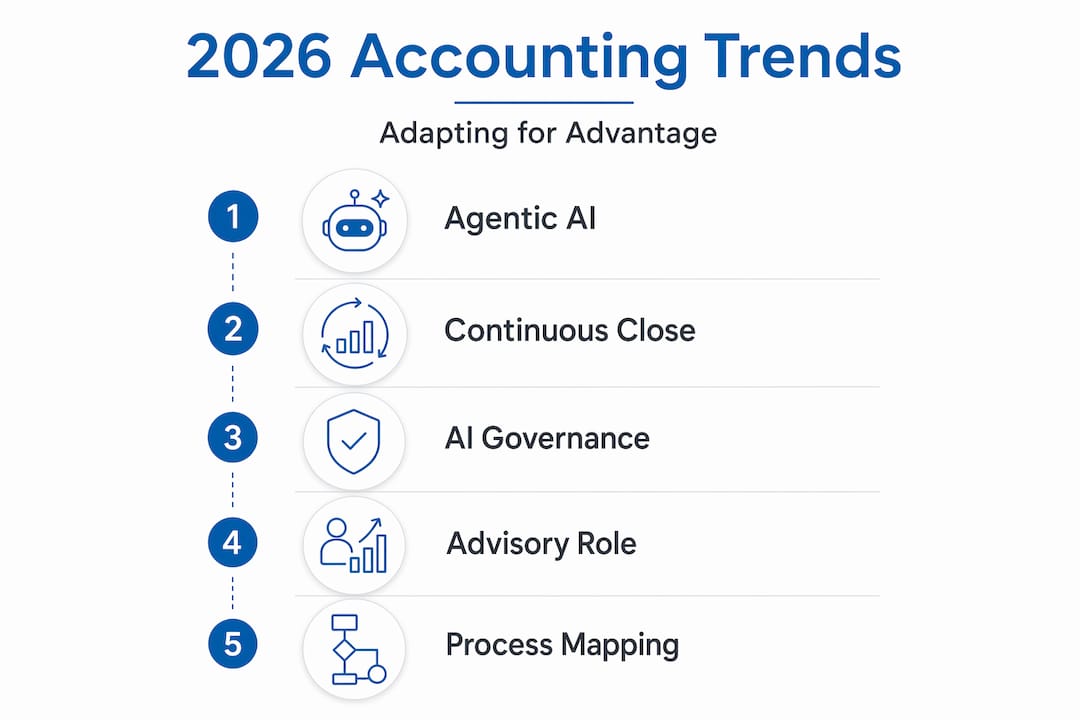
- Agentic AI and accounting workflows in 2026
- The continuous close: speed as a competitive advantage
- Governance-centric AI: the control framework your business needs
- Advisory services: the growth opportunity automation unlocks
- Practical steps to adapt your accounting strategy for 2026
- My perspective on accounting trends and what actually matters in 2026
- How Priceandaccountants helps you stay ahead in 2026
- FAQ
Key takeaways
PointDetailsAgentic AI is reshaping workflowsAutonomous AI handles invoice processing and reconciliation, freeing your team for judgement-driven work.Continuous close is the new standardElite finance teams achieve a Day 0 close through automation, standardised workflows, and real-time data.Governance must precede automationMapping workflows and setting human oversight points before deploying AI prevents costly compliance failures.Advisory services drive firm growth94% of firms now embed advisory in their revenue mix, using automation savings to deepen client value.Process maturity is the real prerequisiteTechnology only delivers results when your underlying processes are documented, consistent, and clean.
Agentic AI and accounting workflows in 2026
Most conversations about the impact of AI on accounting still focus on chatbots and data entry automation. Agentic AI is a different proposition entirely. Rather than responding to prompts, agentic AI systems initiate actions autonomously within defined rules. They process invoices, flag exceptions, run reconciliations, and schedule follow-ups without waiting to be told.
Agentic AI systems in active use today include autonomous accounts payable automation, real-time reconciliation, and exception-based reporting, delivering 30 to 50% efficiency gains across accounting tasks. That is not a marginal improvement. It is a structural shift in how finance teams operate.
The practical impact for your business looks like this:
- Invoice processing happens around the clock without manual input, matching purchase orders to receipts and flagging discrepancies automatically.
- Bank reconciliation runs daily rather than at month end, meaning your cash position is always current.
- Exception handling routes only genuine anomalies to a human reviewer, rather than requiring someone to wade through hundreds of routine transactions.
- Scheduling and reporting tasks that once consumed Friday afternoons are handled by the system before your team arrives Monday morning.
What this does to human roles is the part most leaders underestimate. Finance team roles are shifting from execution to review and judgement. Your team stops being data processors and starts being decision-makers. That transition requires deliberate investment in training, not just in software licences.
Pro Tip: The biggest barrier to agentic AI adoption is not budget. It is process maturity. Map every workflow and identify all human approval points before you consider deploying any automation tool.
The continuous close: speed as a competitive advantage
Month-end close used to be a two-week scramble. Now the industry benchmark has shifted to Day 3, with the most advanced finance teams hitting Day 0 through automation and standardisation. Cycle time reductions of up to 50% are documented for teams that have made this transition properly.
A Day 0 close means your financial position is always current. Decisions do not wait for the books to catch up. But getting there requires more than buying new accounting software innovations. Here is what the transition actually demands:
- Real-time data feeds. Every system touching your finances, from your payment processor to your payroll platform, must push data continuously rather than in batches. Integration is not optional.
- Standardised workflows. Every team member follows the same documented process for every transaction type. Variation is the enemy of a fast close.
- Daily exception review. Instead of reviewing everything at month end, your team reviews only flagged anomalies each day. Volume drops sharply; quality improves.
- Clean data pipelines. Duplicate records, mismatched nominal codes, and inconsistent entity structures will break any automation layer you build on top.
- Defined escalation paths. When the system flags something it cannot resolve, it needs a clear route to the right human. Without this, exceptions pile up and the whole process stalls.
Achieving a continuous close demands a fundamental operating model shift, not just a technology purchase. Teams that simply add automation software on top of undocumented, inconsistent processes find themselves with faster chaos rather than faster clarity.
Pro Tip: Before restructuring your close process, spend two weeks documenting exactly what happens in your current month-end cycle. You will almost certainly discover tasks that exist only because they always have, and those are your first candidates for elimination.

Governance-centric AI: the control framework your business needs
The phrase “AI in accounting” often gets discussed as if adoption is the primary challenge. For most business leaders, the harder question is: once AI is doing things in your finance function, how do you know it is doing them correctly?
COSO guidance published in 2026 urges a clear move from model-centric to governance-centric AI strategies, with audit-ready control mapping as a core deliverable. The shift matters because regulators are watching.
“While AI tools accelerate audit work, auditor accountability remains central. Professional judgement underpins quality.” — Financial Reporting Council, 2026
Practically, a governance-centric approach means building the following into your AI adoption plan:
- Human-in-the-loop escalation. Define exactly which decisions the AI can make independently and which require human sign-off. Document this in writing before deployment.
- Audit-ready control mapping. Every automated process needs a corresponding control that proves it worked correctly. Your auditors will ask for this; build it from day one.
- Regular model review. AI systems trained on historical data can drift. Schedule quarterly reviews of outputs to check for patterns that suggest the model is making errors.
- Documented override procedures. When a human overrides an AI decision, that override must be logged, with a reason. This creates the accountability trail that compliance frameworks require.
The businesses that will struggle in 2026 are those treating AI governance as a box-ticking exercise. Governance done properly is actually a competitive asset. It builds trust with auditors, investors, and clients in ways that speed alone cannot.
Advisory services: the growth opportunity automation unlocks
Here is a number worth sitting with: 94% of firms now embed advisory services in their core revenue mix. The reason is straightforward. When automation handles the compliance workload, skilled accountants have capacity for work that genuinely moves the needle for clients.
For your business, this trend cuts both ways. It means your accounting firm should be offering you more than just filed returns. It also means that AI in accounting is no longer about novelty but about practical operations, and where process maturity is lacking, automation exposes those weaknesses in ways that create demand for advisory support.
What does advisory look like in practice for business leaders? The most valuable engagements in 2026 centre on:
- Rolling 12-month cash flow forecasts updated with live data, rather than static projections built once a quarter.
- Risk intelligence reporting that identifies concentration risks in your customer base, supply chain, or revenue mix before they become crises.
- Scenario modelling for key decisions such as hiring rounds, market expansion, or pricing changes, grounded in your actual financial data.
- Tax strategy alignment with your growth trajectory, particularly for tech founders accessing R&D tax credits or structuring for investment.
The firms delivering this kind of strategic advisory work are differentiating themselves clearly from those still focused on compliance outputs alone. As a business leader, the question is whether your current accounting relationship gives you access to this level of thinking.
Practical steps to adapt your accounting strategy for 2026
Knowing the trends matters less than knowing what to do with them. The table below maps the key accounting trends in 2026 to the specific actions business leaders should take now.
TrendWhat to doWhy it mattersAgentic AI in workflowsAudit and document all current finance processes before selecting toolsAutomation fails on undocumented, inconsistent workflowsContinuous closeIntegrate data sources and standardise nominal coding across all systemsReal-time close is impossible without clean, consistent data pipesGovernance-centric AIBuild a control map and escalation protocol before going liveCompliance and audit readiness depend on documented oversightAdvisory-led accountingAsk your accountant for scenario modelling and forecasting, not just filed returnsYou are paying for expertise; compliance work alone under-uses itEmerging regulationsSchedule a quarterly review of reporting requirements with your adviserTax and reporting rules are shifting faster than most businesses track
Start with the first row. Before investing in any future accounting technologies, spend time understanding what your current processes actually look like. Most businesses discover they are automating workarounds rather than genuine workflows, and that is an expensive mistake to make at scale.
My perspective on accounting trends and what actually matters in 2026
I have worked with enough founders and growing businesses to know that the conversation about accounting technology trends usually goes one of two ways. Either someone is wildly enthusiastic and wants to automate everything immediately, or they are sceptical and want to wait until the market settles. Both positions tend to cost money.
In my experience, the businesses that benefit most from emerging accounting practices in 2026 are the ones that invest in process clarity before technology. I have seen firms deploy impressive AI tools on top of chaotic, undocumented workflows and end up with faster errors. The technology did not fail them. Their process maturity did.
What I find genuinely encouraging about where things are heading is the shift in human roles. When your finance team stops processing and starts reviewing, you get better judgement applied to more meaningful decisions. That is where the real value sits, not in the automation itself but in what the automation makes room for.
The advisory shift is not just a revenue opportunity for accounting firms. For business leaders, it means you should expect more from your financial relationships. The trends in financial analytics and forecasting tools available in 2026 make it possible to have genuinely proactive conversations about your business trajectory. If those conversations are not happening, that is worth examining.
One more thing: governance is not a technical problem. It is a leadership decision. Deciding where humans remain accountable in an AI-assisted finance function is a question that belongs in the boardroom, not just in IT.
— Rahamut
How Priceandaccountants helps you stay ahead in 2026
At Priceandaccountants, we work directly with tech founders, scale-ups, and entrepreneurs who need more than compliance. The accounting trends in 2026 are reshaping what good financial support looks like, and our team is built for exactly that shift.

Whether you need help restructuring your accounting period and close process, building a governance framework for AI adoption, or moving from compliance-only to strategic advisory and tax planning, we bring the expertise and the honest counsel that high-growth businesses actually need. We also support accurate bookkeeping solutions built on modern cloud stacks, giving you the clean data pipelines that make everything else in this article possible. Get in touch with our team to talk through what 2026 should look like for your finance function.
FAQ
What is agentic AI in accounting?
Agentic AI refers to systems that initiate and complete accounting tasks autonomously within predefined rules, such as processing invoices, running reconciliations, and handling exceptions, without waiting for human prompts.
How do the top finance teams achieve a Day 0 close?
Elite teams achieve a Day 0 close by combining real-time data feeds, standardised workflows, and daily exception review. Automation alone is insufficient without clean, consistent data infrastructure underneath.
Why does AI governance matter for business leaders?
COSO guidance stresses that governance-centric AI strategies, with audit-ready controls and documented human oversight, are now an expectation from auditors and regulators, not just good practice.
How is the role of advisory services changing in 2026?
With automation handling routine compliance tasks, advisory services now form the core growth driver for accounting firms, covering forecasting, risk intelligence, and strategic planning rather than just filing returns.
What should a business do before adopting new accounting automation tools?
Map every existing finance workflow thoroughly, identify all human approval points, and clean your data infrastructure. Deploying automation on undocumented processes reliably produces faster, more expensive errors rather than efficiency gains.