

The EIS risk-to-capital condition requires that your company has genuine long-term growth objectives and that investors face significant risk of losing more capital than they could gain from the net return, including tax relief. The practical consequence is immediate: shares should be fully paid ordinary, non-redeemable and free of liquidation preference or any arrangement that protects an investor’s exit. HMRC judges the whole package at the date of issue, and advance assurance obtained beforehand does not guarantee the later compliance check will pass.
TL;DR:
- Shares must be fully paid, non-redeemable, and free of preference rights or protective clauses that guarantee exit or returns at the time of issue.
- The risk-to-capital test is assessed on a principles basis, weighing factors like growth plans, asset security, and governance, all evaluated at share issuance.
- Any contractual arrangement or side letter that guarantees income, capital protection, or profits disqualifies the investment from EIS relief.
- The company’s business plan, legal documents, and cap table must present a consistent story supporting genuine long-term growth and risk.
- Changes to the business plan or refinancing after issuing shares can undermine EIS compliance if not properly documented and aligned before the issue.
Table of Contents
- The statutory test and how HMRC applies it at issue date
- Which share terms and investor arrangements preserve risk to capital
- Aligning your business plan, cap table and investor documents
- Timing, advance assurance and the compliance statement
- Common pitfalls to fix before completing the issue
- How the test plays out across different company scenarios
- What happens if your plans change after the shares are issued
- Rahamut’s perspective: what a compliant issue actually requires
- How Price & Accountants can help you structure a compliant issue
- Sources
- FAQ
The statutory test and how HMRC applies it at issue date
Section 157A of the Income Tax Act 2007 sets out the risk-to-capital condition in two parts. The company must have objectives to grow and develop its trade over the long term, and there must be a significant risk that the investor will lose more capital than the net amount they could gain, once relief is factored in, under the statutory wording.
HMRC does not apply a checklist with a single decisive factor. Instead, the risk-to-capital condition is a principles-based gateway introduced by the Finance Act 2018, designed to keep relief flowing to patient capital in companies with real growth ambitions rather than tax-driven capital preservation schemes.
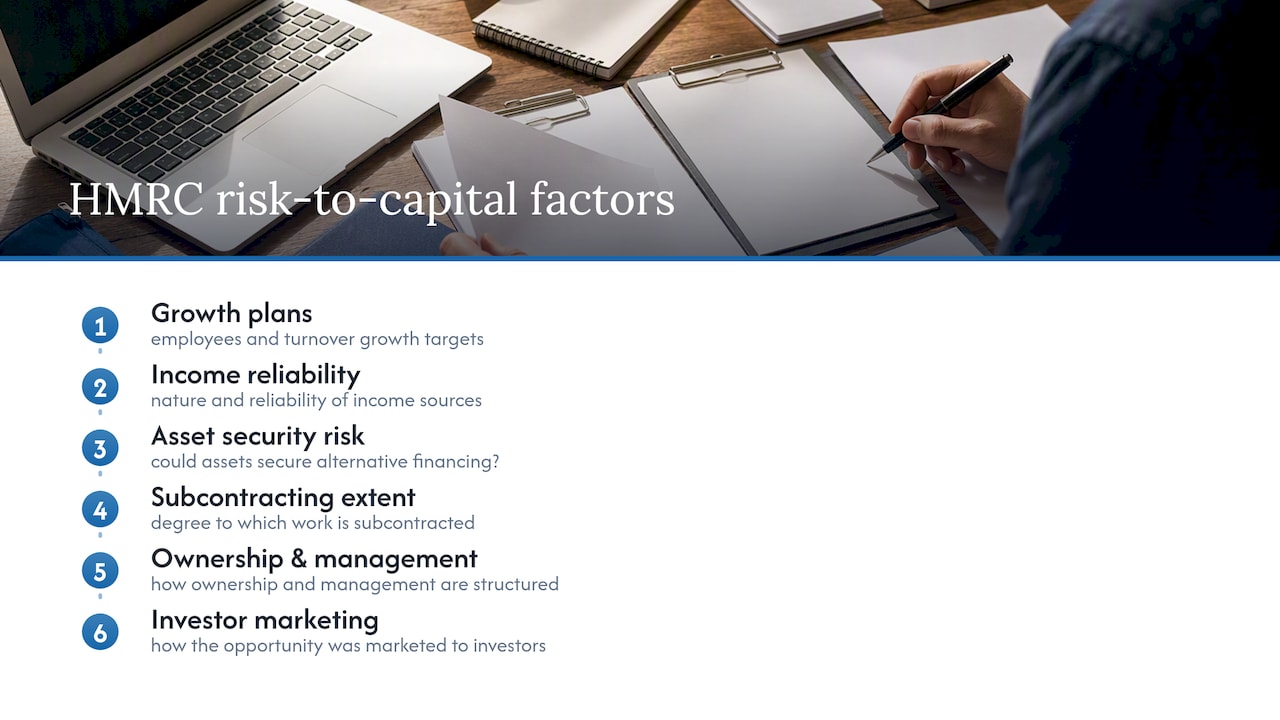
When HMRC reviews a case, it weighs a set of non-exhaustive factors together: whether the company plans to grow employees and turnover, the nature and reliability of its income sources, whether assets could be used to secure alternative financing, the extent of subcontracting, how ownership and management are structured, and how the opportunity has been marketed to investors. No single factor is fatal on its own, but several pointing the same way build a strong case against qualification.
Crucially, this assessment happens at the moment the shares are issued, not at some later review point. Net investment return, for these purposes, includes the value of EIS tax relief itself, so a deal that looks low-risk once relief is added back can still fail the test.
Which share terms and investor arrangements preserve risk to capital
The shares themselves need to be unambiguous. HMRC’s guidance is that qualifying shares must be fully paid ordinary shares, non-redeemable, and carrying no special rights to company assets on a winding-up. Anything that looks like debt dressed as equity, or equity with a safety net, undermines the case.
There is a narrow exception for preferential dividends: a limited preferential right is acceptable, but only where it cannot accumulate and cannot be varied. Draft this carefully and stress-test it against realistic cashflow scenarios, because an apparently modest dividend right can look like a guaranteed return if the company’s finances make payment near-certain.
Several contractual features are red flags or outright disqualifying:
- Redemption rights or compulsory buybacks that let the company or investor force an exit on fixed terms.
- Liquidation preference or any priority over other shareholders on a winding-up.
- Guaranteed exits, whether through a pre-agreed sale, a put option or a call option.
- Side letters that promise capital protection, fee rebates or assured income outside the main share terms.
Pro Tip: Never assume the word “ordinary” on the share certificate settles the question: HMRC and its advisers look at the whole commercial package, including side letters and subscription agreements, not just the share class name.
Labelling shares “ordinary” changes nothing if a subscription agreement or side letter quietly guarantees the investor’s money back. HMRC’s own guidance treats any arrangement that assures income, fees, interest, capital growth or the value of tax relief as evidence the investment is not genuinely at risk.
Aligning your business plan, cap table and investor documents
HMRC does not assess share terms in isolation. It reads the whole story your documents tell, so the commercial narrative has to support genuine risk and genuine growth intent.
- Your business plan and use-of-funds narrative should set out growth metrics, hiring plans, product development milestones and how revenue will scale, giving HMRC a credible basis for the long-term growth limb of the test.
- Cap table hygiene matters: founders retaining meaningful equity and board control signals a genuine growth business, whereas a promoter-controlled investor base or fragmented SPV structure can look engineered purely to multiply relief.
- Articles of association, the subscription agreement, any information memorandum and side letters all need to say the same thing; a business plan promising rapid scaling sits badly beside a subscription agreement with a guaranteed buyback clause.
Internal consistency is the point. A single stray clause in a side letter, inconsistent with everything else, is often what turns a qualifying round into a rejected one. Founders raising SEIS alongside EIS should also check the eligibility criteria for each scheme line up with the same underlying plan.
Timing, advance assurance and the compliance statement
Advance assurance is a pre-issue check where HMRC gives an informal view on whether a proposed share issue is likely to qualify. It has real limits: it cannot be requested after shares are issued, and it is not a final determination of compliance, which is assessed separately once the company submits its compliance statement.
A workable timetable looks like this:
- Prepare the business plan, cap table, articles and subscription documents together, so they tell one consistent story.
- Seek advance assurance before any shares are issued, using the finalised documents rather than a draft.
- Issue the shares once assurance and legal review are complete.
- Submit the EIS1 compliance statement to HMRC after issue.
- Once approved, HMRC issues authority for the company to give investors their EIS3 certificates, which they need to claim relief.
Build in time for specialist tax and legal review before completion. Rushing to close a round before advance assurance is confirmed is one of the most common and avoidable causes of failed claims.
Common pitfalls to fix before completing the issue
Most failed EIS claims trace back to a handful of recurring defects, usually spotted too late.
- Priority on assets or a liquidation preference buried in the articles rather than the headline share terms.
- Pre-agreed exit mechanics, such as a put option triggered after a fixed period.
- Investor-held control through board majorities or veto rights that go beyond normal minority protections.
- SPV fragmentation designed mainly to multiply relief across related entities rather than fund genuine growth.
- Protected income streams that make the investor’s return look assured regardless of company performance.
Pro Tip: Fix these before advance assurance, not after: reworking a subscription agreement once investors have signed is far harder than drafting it correctly the first time.
The corrective steps are usually straightforward once identified: strip out or rework protective clauses, confirm founders keep control and a meaningful stake, and make sure the marketing materials, cap table and legal documents tell one consistent story. A single specialist review that tests articles, subscription agreements, side letters and business plan together, rather than checking each document separately, catches the inconsistencies that HMRC will also find.
How the test plays out across different company scenarios
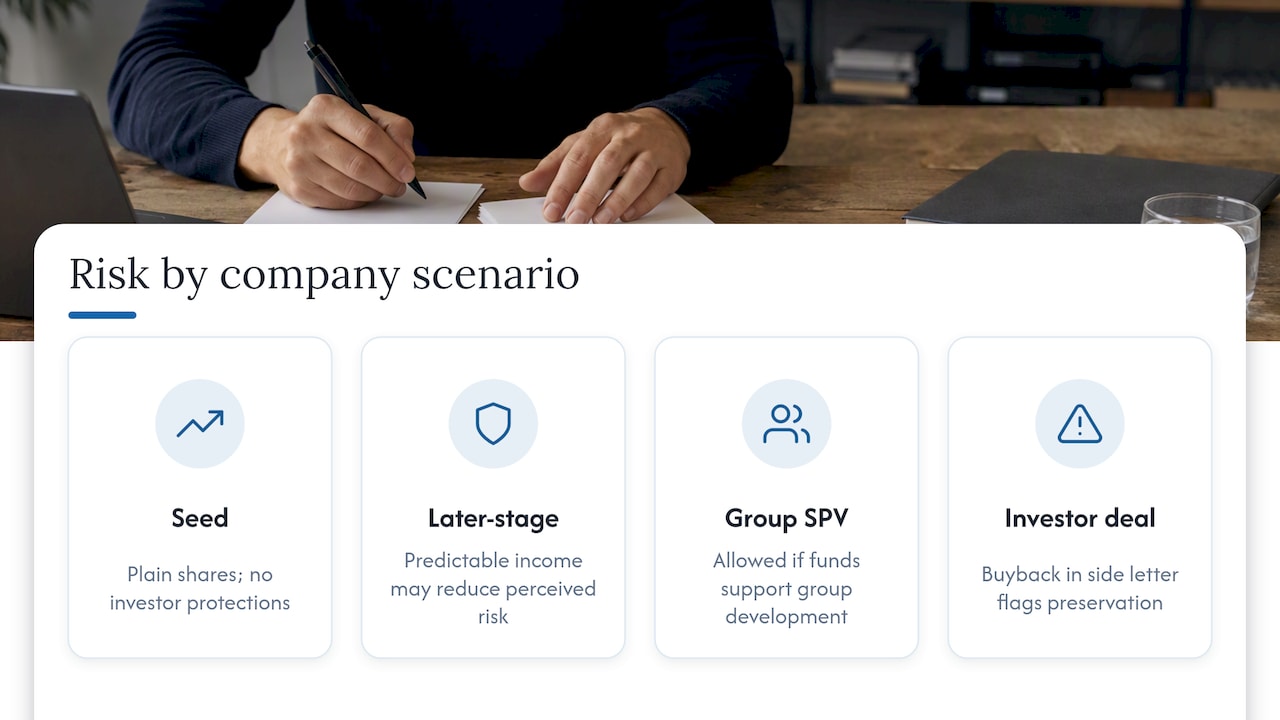
A seed-stage software company raising its first external round, issuing plain ordinary shares with no side letters, is the easiest case: growth objectives are self-evident from the product roadmap and hiring plan, and there is no arrangement protecting investor capital.
A later-stage company that has already generated steady contract revenue faces closer scrutiny. If income is highly predictable and assets could readily secure a bank loan instead, HMRC may question whether the risk is genuinely significant, even where the shares themselves are correctly drafted.
A group structure raising money through a subsidiary or SPV is permissible where the funds genuinely support long-term development of the wider group and entrepreneurial control stays with the founding team. It becomes a red flag when the SPV exists mainly to multiply the number of qualifying issues rather than to fund real trading activity.
A company that has negotiated an investor-friendly deal, perhaps under pressure from a lead investor asking for a buyback right after three years, is the riskiest scenario of all. Even a single such clause, tucked into a side letter rather than the main agreement, can be enough for HMRC to treat the whole package as capital preservation rather than genuine risk capital.
What happens if your plans change after the shares are issued
The risk-to-capital assessment is made at the point shares are issued, but that does not mean the company’s obligations end there. If the business plan submitted to support advance assurance changes materially before or shortly after issue, without the underlying documents being updated, HMRC can question whether the original assurance still reflects reality.
A common scenario is a company that raises EIS funds for one growth strategy, then pivots the business model within months, changing its income sources or asset base substantially. That is not automatically fatal, but it removes the comfort of an assurance based on the old plan and increases scrutiny at the compliance statement stage.
Refinancing shortly after an EIS round can raise similar questions, particularly if new investors receive terms (such as a guaranteed exit or priority on assets) that were absent from the original round. Consistency across financing rounds matters because HMRC and its advisers will look at the company’s arrangements in the round, not just the specific issue under review.
The practical lesson is to treat the business plan and cap table as living documents that need periodic review, not a one-off exercise completed for advance assurance and then filed away. Keeping legal and tax advisers involved as the company grows reduces the risk that a later event undermines an EIS claim made in good faith at the time.
Rahamut’s perspective: what a compliant issue actually requires
I lead our funding and investment work at a specialist UK accounting and tax consultancy with extensive experience in EIS and SEIS compliance. Most compliance failures we see come from documents drafted in isolation: a clean set of articles undone by a side letter nobody flagged.
Our pre-issue work typically covers document review across articles, subscription agreements and side letters, support through the advance-assurance process, checking the cap table against the business plan, and helping prepare the EIS1 compliance statement once shares are issued. The pattern is always the same: catch the inconsistency before completion, not after.
— Rahamut
How Price & Accountants can help you structure a compliant issue
Getting the risk-to-capital condition right means reviewing share terms, subscription agreements and your business plan as one connected package, not three separate jobs. That is exactly where a generalist accountant tends to miss the detail that HMRC will not.

We work with founders from pre-seed through Series A on the specific mechanics of EIS and SEIS compliance, alongside the wider accounting and tax work that keeps a growing company on track.
- Pre-issue document review covering articles, subscription agreements, side letters and the business plan together.
- Advance-assurance support and guidance on timing before you issue shares.
- Cap table and business-plan alignment so your fundraising story is consistent throughout.
- EIS1 compliance statement filing assistance once shares are issued.
These sit within our Core Services, Blue Plan and Black Plan, alongside outsourced finance director support for companies that want ongoing oversight through further rounds. If you are preparing a raise, book a compliance review before you approach investors, not after documents are signed.
Sources
FAQ
What is the EIS risk-to-capital condition in simple terms?
It is a two-part legal test requiring your company to have genuine long-term growth objectives and requiring a significant risk that investors could lose more capital than they gain, including relief, under section 157A. Both limbs must be met at the point shares are issued.
Can preferential dividends ever qualify for EIS?
Yes, but only within narrow limits: HMRC guidance allows a limited preferential dividend right provided it cannot accumulate and cannot be varied. Anything beyond that risks being treated as a protected return rather than genuine risk capital.
Does advance assurance guarantee my EIS claim will succeed?
No, advance assurance is a pre-issue indication from HMRC and cannot be requested once shares have been issued, nor does it replace the later compliance check. Companies must still submit a compliance statement after issue and align every document with what HMRC reviewed.
What happens if our business plan changes after we raise EIS funding?
A material change to the business plan or financing shortly after issue does not automatically break compliance, but it can undermine the assurance previously given if the underlying documents are not updated. Keeping legal and tax advisers involved as the company evolves reduces this risk.
How can Price & Accountants help with EIS compliance?
Price & Accountants reviews share terms, subscription agreements and business plans together to identify inconsistencies before completion, and supports advance-assurance applications and EIS1 filings. These services sit within the Core Services, Blue Plan and Black Plan available to UK tech and fintech startups.