
Most lean UK tech businesses end up worse off on the VAT Flat Rate Scheme once the 16.5% limited cost trader rate applies. You can join at £150,000 taxable turnover excluding VAT and must leave once VAT-inclusive turnover passes £230,000, with computer and IT consultancy normally set at 14.5%. This article shows how to run the quick test yourself and what to check before deciding.
TL;DR:
- Most tech consultancies spending mainly on cloud tools, subscriptions, and rent will likely be pushed onto the 16.5% limited cost trader rate, erasing the scheme’s advantage.
- Businesses with significant input VAT on assets like laptops or office equipment are more likely to benefit from standard VAT accounting rather than the flat rate scheme.
- Running the last four quarters’ purchase data through the limited cost test helps identify the best scheme, rather than relying on assumptions or sector averages.
- The flat rate scheme offers predictable VAT payments but typically reduces VAT refunds, making standard accounting preferable for businesses with large input VAT claims.
- Continuous quarterly checks are essential to stay compliant, as the scheme’s thresholds and rules for limited cost traders change regularly.
Table of Contents
- What the flat rate scheme is and who can join
- How the flat rate calculation works for tech businesses
- Limited cost trader rules: the decisive test for most tech firms
- When standard VAT accounting beats the flat rate scheme for tech businesses
- How to join, leave and keep records under the flat rate scheme
- Interaction of the scheme with digital services VAT rules and Brexit changes
- Impact of the scheme on cash flow and VAT refund timings
- How to assess if the scheme benefits your type of tech business
- Detailed examples illustrating VAT calculation for tech businesses under the scheme
- What we see working for UK tech startups
- How Price & Accountants can help your tech business with VAT decisions
- Authoritative GOV.UK pages and HMRC tools
- FAQ
What the flat rate scheme is and who can join
The Flat Rate Scheme lets a VAT-registered business pay HMRC a fixed percentage of its VAT-inclusive turnover, rather than working out the difference between VAT charged and VAT paid on every purchase. You still charge customers the normal 20% VAT rate on invoices, but the sum you hand over to HMRC is calculated differently.
To join, your estimated taxable turnover, excluding VAT, needs to be £150,000 or less at the point you apply. You must leave the scheme once your VAT-inclusive turnover for the previous 12 months goes above £230,000, checked at each anniversary of joining.
This sits alongside the separate question of whether you need to register for VAT at all. The standard VAT registration threshold is £90,000, so many small tech consultancies cross into VAT territory well before they get anywhere near the FRS exit point.
- You must already be VAT-registered before applying for the Flat Rate Scheme.
- HMRC publishes an online calculator to check your sector rate and limited cost trader status.
- The £150,000 and £230,000 figures are both measured differently, excluding VAT and including VAT respectively.
How the flat rate calculation works for tech businesses
Under the scheme, you apply your sector’s flat rate percentage to your total VAT-inclusive turnover for the quarter, not to the VAT you have actually charged. You still invoice clients at the normal rate, typically 20%, but the amount you pay HMRC is a smaller percentage of a bigger number.
Computer and IT consultancy or data processing sits at 14.5% in HMRC’s sector schedule. Newly VAT-registered businesses get a 1% discount on their applicable rate for their first year, which drops that 14.5% to 13.5% for eligible new registrants.
Say a consultancy invoices £10,000 plus VAT in a quarter, so £12,000 including VAT. Under standard accounting, if it has almost no reclaimable input VAT, it owes HMRC the full £2,000 charged. Under the flat rate scheme at 14.5%, it would pay 14.5% of £12,000, which is £1,740.
Pro Tip: Run the same quarter’s numbers through both methods before you commit. It only takes a spreadsheet and last quarter’s invoices.
The full schedule of sector rates sits in HMRC’s guidance, and it is worth checking your own sector code against it directly.
Limited cost trader rules: the decisive test for most tech firms
This is the rule that changes everything for service-led tech businesses. HMRC introduced a 16.5% flat rate for limited cost traders to stop businesses exploiting the lower sector percentages while barely buying any goods.
“Relevant goods” has a narrow meaning here.
- Services, including subscriptions, software licences and most cloud tools, do not count as relevant goods.
- Capital expenditure, rent and professional fees are excluded from the test entirely.
- Only tangible goods used exclusively for the business, like stock or equipment, generally qualify.
A tech consultancy spending mainly on SaaS subscriptions, contractor fees and office rent will almost always fail this test and be pushed onto the 16.5% rate, which erases most of the scheme’s usual cash advantage.
The test applies period by period, not once at registration, so check it every quarter using HMRC’s calculator rather than assuming last year’s answer still holds.
When standard VAT accounting beats the flat rate scheme for tech businesses
Standard accounting tends to win whenever you have meaningful input VAT to reclaim. The Flat Rate Scheme generally blocks that reclaim, with one exception: a single capital purchase over £2,000 including VAT can still be reclaimed separately.
- Estimate your input VAT on likely purchases over the next 12 months, including laptops, servers or an office fit-out.
- Compare that reclaimable figure against the gap between your standard VAT liability and your flat rate liability at your sector percentage.
- Factor in the 1% first-year discount if you are newly registered, since it narrows the gap for roughly your first four VAT returns.
- If reclaimable input VAT exceeds the flat rate saving, standard accounting almost always comes out ahead.
A developer buying a £2,400 laptop reclaims the VAT on it either way, since that single purchase clears the £2,000 concession threshold. A business fitting out a new office, or buying several laptops across a quarter that individually sit under £2,000, loses that VAT entirely under FRS.
Pro Tip: List every planned purchase for the next year before choosing a scheme. A handful of hardware refreshes can flip the decision.
How to join, leave and keep records under the flat rate scheme
Joining and leaving the scheme, and staying compliant once you are on it, follows a fairly fixed pattern.
- Apply through your VAT online account or by post, confirming your estimated taxable turnover is £150,000 or under.
- File quarterly VAT returns through Making Tax Digital compatible software, since MTD rules apply to flat rate businesses in the same way as standard VAT registrants.
- Calculate your flat-rate turnover as your total VAT-inclusive income for the period, including exempt and zero-rated supplies where relevant.
- Keep receipts for anything you count as relevant goods, a running VAT account, and a note of your limited cost trader test result each quarter.
- Check your VAT-inclusive turnover against the £230,000 exit threshold at each anniversary of joining, and notify HMRC if you go over.
If any of this feels like guesswork, an accountant can model both schemes against your actual invoices and purchase history rather than rough estimates. That modelling matters more for tech businesses than most, given how often the limited cost test bites.
Interaction of the scheme with digital services VAT rules and Brexit changes
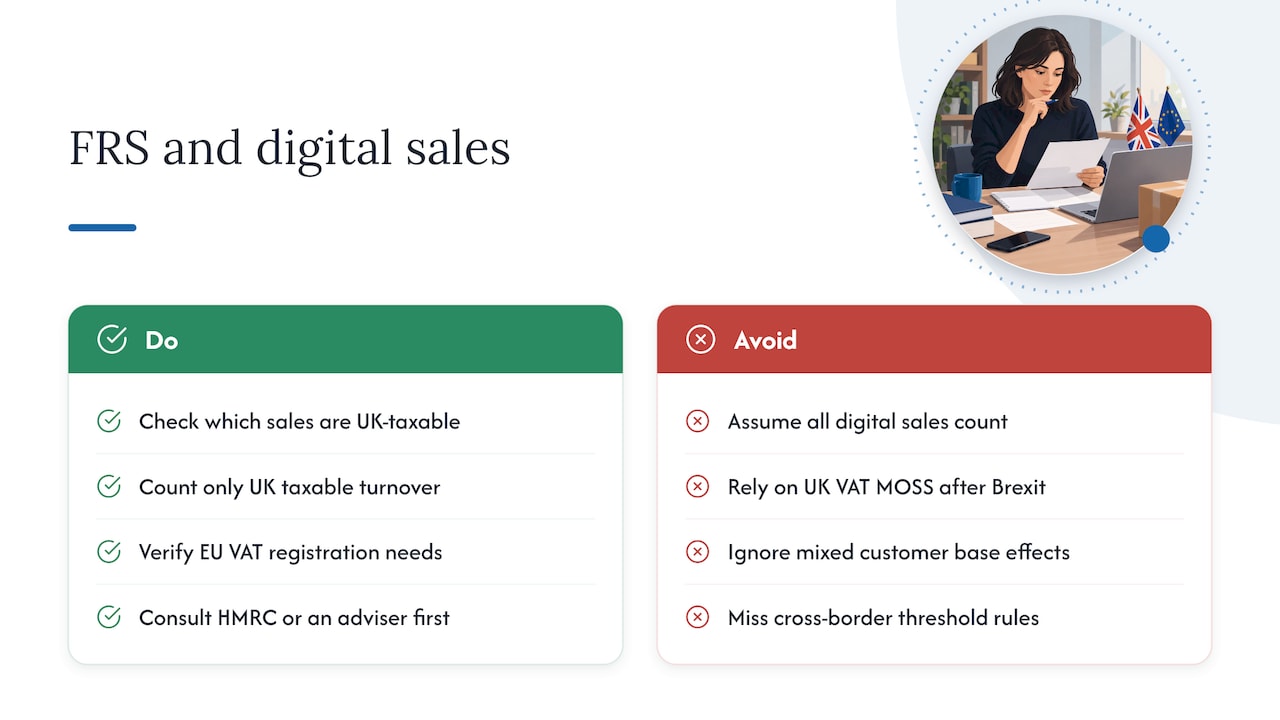
Digital services VAT rules and the UK’s post-Brexit position add a layer that many tech founders overlook when weighing up the Flat Rate Scheme. If you sell digital services, software as a service or downloadable products to consumers outside the UK, those sales may fall under different VAT treatment depending on the customer’s location, separate from the flat rate percentage you apply to your UK-taxable turnover.
Since the UK left the EU VAT area, UK businesses selling digital services to EU consumers generally need to consider EU VAT registration or the EU’s non-union scheme, rather than relying on UK VAT MOSS, which closed to UK businesses at the end of the Brexit transition period. None of that changes your UK Flat Rate Scheme obligations directly, but it does change what counts as UK taxable turnover for the £150,000 and £230,000 thresholds.
A practical consequence: a tech business with a mixed customer base, some UK, some EU, some further afield, needs to work out which revenue streams count towards its FRS turnover tests before assuming it is comfortably under or over a threshold. Getting this wrong in either direction creates compliance risk, either an incorrect flat rate application or a missed deregistration deadline. For any business with meaningful non-UK digital sales, this is worth checking against current HMRC guidance or with an adviser before joining or renewing on the scheme, since the interaction between domestic thresholds and cross-border digital sales rules is not always intuitive from the flat rate guidance alone.
Impact of the scheme on cash flow and VAT refund timings
Cash flow is where the Flat Rate Scheme’s appeal and its cost both show up most clearly. Because you pay a fixed percentage of turnover rather than reconciling VAT charged against VAT paid, your quarterly VAT bill becomes more predictable, which some founders value when forecasting outgoings.
The trade-off is timing on refunds and reclaims. Under standard accounting, a business with high upfront costs, such as one investing heavily in equipment before revenue ramps up, can find itself in a VAT repayment position, where HMRC owes it money rather than the other way round. Under the Flat Rate Scheme, that repayment route mostly disappears outside the £2,000 capital goods concession, so cash that would have come back from HMRC simply does not.
For a tech business with lumpy spending, a big infrastructure purchase in one quarter and very little in the next, standard accounting smooths cash flow better because refunds land when the spending happens. The Flat Rate Scheme smooths the VAT bill itself but not the underlying cash position, since you still pay a percentage of turnover regardless of what you spent that quarter. Founders who value predictability in their VAT bill over the possibility of a refund tend to prefer FRS, while those managing tight working capital around capital purchases usually find standard accounting kinder to cash flow.
How to assess if the scheme benefits your type of tech business
The right test depends heavily on your business model, not just your sector code. A few patterns are worth checking against your own numbers.
For these businesses, the Flat Rate Scheme rarely helps beyond the first-year 1% discount window.
Consultancies and agencies billing largely for time, with occasional equipment purchases, sit in similar territory.
Businesses with genuinely higher goods spend, reselling hardware, running a managed services desk with stock, or bundling physical devices into client contracts, are more likely to stay under the standard sector rate and see a real benefit, since their relevant goods spend can clear the 2% or £1,000 threshold naturally.
The practical move is to run your last four quarters of actual purchase data through the limited cost test rather than guessing from your business description.
Detailed examples illustrating VAT calculation for tech businesses under the scheme
Take a two-person software consultancy billing £15,000 plus VAT in a quarter, so £18,000 including VAT, with negligible goods spend beyond a coffee machine and some stationery. Under standard accounting, assuming minimal reclaimable input VAT, it would owe the full £3,000 VAT charged, so the scheme saves it £30 that quarter, a narrow margin easily wiped out by admin time or a single unreclaimed purchase.
With the 1% first-year discount, its effective rate is 13.5%. On £18,000, that is £2,430, a genuine saving of £570 against the £3,000 standard liability.
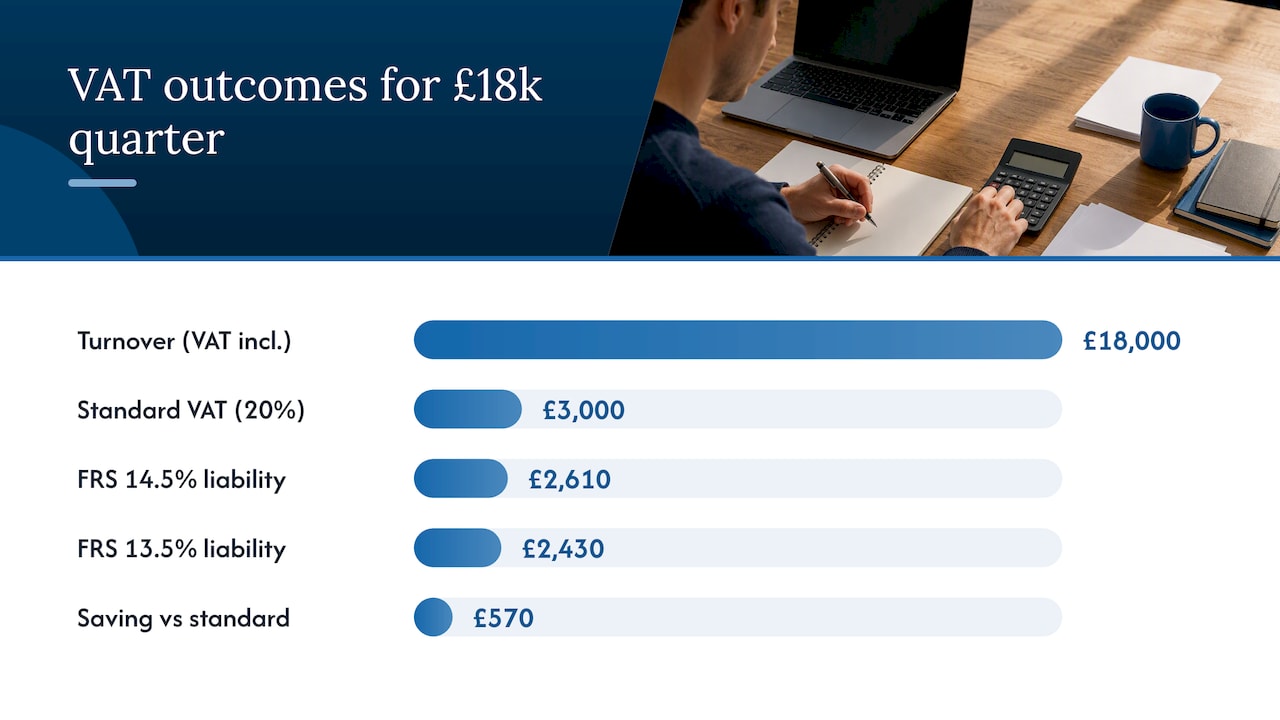
The difference between these two scenarios is entirely about whether relevant goods spend clears the limited cost threshold in that specific quarter, which is why testing every period matters more than picking a scheme once and leaving it unchecked.
What we see working for UK tech startups
Most lean tech consultancies we work with find the Flat Rate Scheme unfavourable once the limited cost trader rule bites, usually within their first year or two of trading.
Where we tend to add value is in the modelling: running the limited cost test against actual purchase history rather than assumptions, checking whether a business would be better off leaving the scheme before its next anniversary, and keeping VAT records Making Tax Digital ready so the decision can be revisited each quarter without a scramble.
— Rahamut
How Price & Accountants can help your tech business with VAT decisions
Working out whether the Flat Rate Scheme suits your business shouldn’t mean guessing from a government table. We model both methods against your actual invoices and purchase history, check your limited cost trader status quarter by quarter, and handle the VAT return filing once you know which scheme fits.

Our cloud accounting work runs on Xero, so your VAT position stays visible in real time rather than surfacing as a surprise at quarter-end. If you want a straight answer on whether standard accounting or the Flat Rate Scheme suits your business, view our pricing plans, including Core Services from £249 a month, and get in touch to have your numbers run properly.
Authoritative GOV.UK pages and HMRC tools
For the full detail behind this article, HMRC’s VAT Notice 733 covers the scheme’s rules, rates and capital goods concession in full. GOV.UK also hosts an online calculator to test your limited cost trader status and sector rate directly against your own figures before you decide. If you are digitalising your bookkeeping to keep MTD-ready records, structured workflow guidance can help you set up the right processes from the start.
This article is general information, not a substitute for advice from a qualified financial advisor. Consult a qualified financial professional about your own circumstances before acting on anything here.
FAQ
How much is a flat rate scheme?
The rate depends on your sector and limited cost trader status. Computer and IT consultancy sits at 14.5%, newly registered businesses get a 1% first-year discount, and limited cost traders pay 16.5% regardless of sector.
Why is HMRC doing MTD?
Making Tax Digital requires VAT-registered businesses, including those on the Flat Rate Scheme, to keep digital records and file returns through compatible software. It applies whichever VAT accounting method you use, so record-keeping needs to be MTD-ready from registration.
What are the new VAT rules for 2026 in the UK?
There is no separate 2026-specific Flat Rate Scheme change; the current thresholds are the £150,000 join point and £230,000 exit point, alongside the £90,000 VAT registration threshold in force since April 2024. Businesses with cross-border digital sales should also check how EU VAT rules apply to their turnover following Brexit.
What is HMRC flat rate?
It is a VAT accounting method where you pay HMRC a fixed percentage of your VAT-inclusive turnover instead of reconciling VAT charged against VAT reclaimed. You still charge customers standard VAT, but your payment to HMRC is calculated using your sector’s set percentage.