
An investor data room is a secure, permission-controlled repository where founders and companies share financial, legal and commercial documents during fundraising or acquisition review. The single most important action is to build a clean, indexed room with one named owner before investors ask for it. A well-organised room speeds up due diligence and reduces investor friction, which lowers the risk of a lower valuation later in the process.
TL;DR:
- Having a well-organized, indexed data room prepared before investor interest emerges reduces delays and errors during fundraising or acquisition processes.
- Ensure strict control features like individual access, dynamic watermarks, and audit logs to prevent leaks and enable precise activity tracking.
- Prioritize current, properly reconciled legal, financial, and tax documents, especially cap tables and SEIS/EIS paperwork, to satisfy different investor tiers and compliance needs.
- Use a clear folder structure with a “Read me first” guide and consistent numbering to streamline investor review and minimize search time.
- Regularly update the room, assign ownership, and rehearse review procedures to speed up due diligence and avoid common mistakes that cause deal delays.
Table of Contents
- What an investor data room does and when you need one
- Investor-ready document checklist (what to include, tier by tier)
- Folder structure and the ‘read me first’ index
- Security baseline and compliance checklist before you choose a platform
- Managing investor access and the Q&A process
- Keeping the room ready: timeline and ownership
- Common mistakes that delay deals
- How Price & Accountants helps founders prepare investor-ready data rooms
- Choosing a virtual data room platform
- Best practices for investor engagement through the data room
- Tailoring the data room to different investor types
- Legal and compliance risks beyond local rules
- Author perspective: practical priorities for founders versus fund managers
- How Price & Accountants can help
- Sources
- FAQ
What an investor data room does and when you need one
A data room exists to answer the questions investors, lenders or acquirers will ask before they commit money. It covers fundraising rounds, mergers and acquisitions, lender covenant reviews and statutory audits, and the content shifts slightly for each: a lender wants covenant compliance and cash flow detail, while an acquirer wants contracts and liabilities that survive a sale.
A virtual data room is not the same thing as a shared folder on Google Drive or Dropbox. The difference lies in control: a proper VDR lets you set per-document permissions, track exactly who opened what and when, apply dynamic watermarks to discourage leaks, and revoke access instantly if a conversation ends. A shared drive offers none of that, and once a file is downloaded you have no way to track where it goes next.
You need a data room the moment a lead investor shows serious interest, not after the first term sheet lands. Waiting until a request arrives means scrambling to assemble documents under time pressure, which is when mistakes creep in.
Signs it is time to set one up:
- A lead investor has asked for financials, a cap table or a product roadmap beyond the pitch deck.
- You are entering a structured process with multiple parties reviewing in parallel.
- A lender or acquirer has issued a formal information request list.
- Your last round’s documents are more than a year old and need refreshing before a new raise.
Treat the room as a standing piece of company infrastructure rather than a one-off task tied to a single round. Businesses that keep theirs current move faster the next time money is on the table.
Investor-ready document checklist (what to include, tier by tier)
Investors do not ask for everything at once. They request documents in waves, and matching your room’s structure to that rhythm avoids both information overload and awkward gaps.
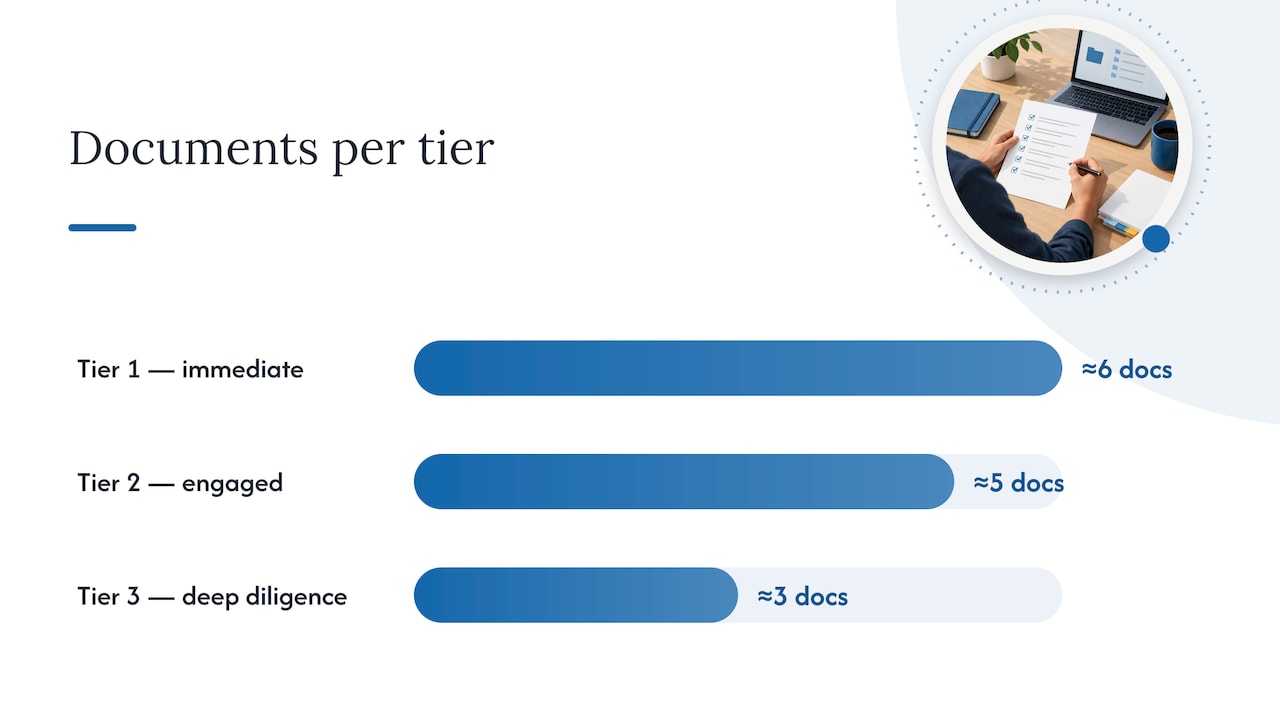
Tier 1: documents requested immediately. These are what a lead investor reviews before deciding whether to proceed to term sheet.
- Pitch deck and one-page executive summary.
- Capitalisation table showing current ownership, options and any convertible instruments.
- Historical and current management accounts, typically the last 12 to 24 months.
- Financial model and forecast, with assumptions stated separately.
- Certificate of incorporation and memorandum and articles of association.
Tier 2: requested once the investor is engaged but before signing. This is where legal and operational substance gets tested.
- Board minutes and shareholder resolutions for the past two years.
- Intellectual property assignment agreements from founders and contractors.
- Material commercial contracts, including customer and supplier agreements above a set value threshold.
- Employment agreements and consultancy contracts for key staff.
- Insurance policy summaries where relevant to the business risk profile.
Tier 3: deep diligence items, usually requested by institutional investors or during an acquisition process rather than an early-stage priced round.
- Corporation tax returns and HMRC correspondence for the past three years.
- Detailed insurance schedules and claims history.
- Full vendor and supplier contracts, including termination clauses.
For UK fundraising specifically, SEIS/EIS paperwork deserves its own folder rather than being buried in the tax section. This includes advance assurance letters, SEIS1 or EIS1 submissions, and the SEIS2 or EIS2 authorisation letters that investors need to claim their relief. Guidance for UK funding rounds is clear that cap table entries must reconcile exactly with Companies House SH01 filings, because a mismatch here is one of the fastest ways to stall a close.
A clean, well-indexed room with a master index is one of the strongest signals of investor readiness, according to GOV.UK guidance on data room essentials. Investors read the state of your data room as a proxy for the state of your operations.
Folder structure and the ‘read me first’ index
A room that makes investors hunt for documents wastes goodwill you need for the negotiation itself. A consistent folder tree, paired with a short index document, solves most of that friction before it starts.
- Start with a top-level folder per category: Corporate, Financial, Legal & IP, Commercial, HR & Governance, and Regulatory & Tax. Keep the structure flat enough that nothing sits more than three folders deep.
- Place a “Read me first” document at the root. It should list every folder, summarise what is inside each one, flag anything unusual (a lapsed contract, a pending renewal) and name the person to contact with questions.
- Number folders and files consistently, for example “02 Financial” and inside it “02.1 Management Accounts FY25”. Numbers keep the tree sorted in the order investors expect to review it.
- Date every filename using the same format, such as “SH01_Allotment_2026-03-14.pdf”, rather than relying on each document’s internal date, which investors cannot see from the folder view.
- Version documents explicitly. A financial model should read “Model_v4_2026-02.xlsx” rather than “Model_final_FINAL.xlsx”, which tells an investor nothing about what changed or when.
- Remove drafts and superseded files rather than leaving them alongside the current version. A room with three versions of the same contract invites the question of which one is binding.
The “Read me first” document doubles as a diligence shortcut: a sharp investor will skim it in under a minute and form an early impression of how organised the company is. That impression carries into how closely they scrutinise everything else.
Security baseline and compliance checklist before you choose a platform
Most virtual data room providers advertise security, but the detail matters more than the marketing. Before committing to a platform, confirm the following controls are present and active, not just listed on a features page.
- AES-256 encryption at rest and TLS encryption in transit, so documents are protected both while stored and while moving between the platform and a user’s device.
- Mandatory multi-factor authentication for every user, with no option for a recipient to opt out.
- Dynamic, per-user watermarking on viewed and downloaded documents, so a leaked file can be traced to the account that accessed it.
- A complete, exportable audit trail logging every view, download and permission change by user and timestamp.
These controls, along with ISO 27001 and SOC 2 Type II certification, form the baseline that serious transaction VDRs should meet. Certification alone is not the whole story, though. A signed Data Processing Agreement, confirmation of EU data residency where that applies to your investors, and clarity on where backups are stored all sit outside the certificate and inside the contract you sign with the provider. Compliance guidance for 2026 makes the point that a certified provider still needs active operational controls enforced by the founder, not assumed from the badge on their homepage. Fund managers and regulated entities handling UK or EU investor data should also check whether the provider’s resilience arrangements align with the Digital Operational Resilience Act, which applies to financial entities and their critical third-party providers.
For larger or more sensitive rounds, some platforms offer advanced options worth asking about: customer-managed encryption keys, session time limits that log users out automatically, and device trust checks that block access from unrecognised hardware.
Pro Tip: Ask any shortlisted provider for their ISO 27001 certificate and most recent SOC 2 Type II report directly, rather than trusting a badge on their marketing page.
Managing investor access and the Q&A process
Access control is where most data room mistakes happen, because founders default to convenience over traceability. Treat every recipient individually rather than issuing one shared link to the whole room.
- Issue per-recipient links so each investor’s activity is logged separately, and set tiered permissions so a lead investor sees more than a secondary one still deciding whether to participate.
- Gate sensitive folders, particularly Tier 2 and Tier 3 material, behind NDA acceptance captured electronically, which creates a defensible record if confidentiality is ever disputed.
- Run Q&A through a structured module rather than e-mail threads: log each question, assign it to the right internal owner, version the answer if it changes, and keep the full exchange visible to your team.
- Review engagement data weekly during an active round: who has returned to the financial model more than once, who has barely opened the room, and who is reading contracts closely. Vendor guidance on fundraising rooms notes that repeated visits to financial detail are a more reliable signal of serious intent than a single long first visit.
Per-recipient links combined with captured NDA acceptance give you a genuinely defensible audit trail if a dispute arises later, which a shared link or bulk e-mail attachment never can.
Use engagement metrics to decide where to spend your own time. An investor who has not opened the room in two weeks needs a call, not another document.
Keeping the room ready: timeline and ownership
A hot fundraising round typically runs on a compressed two to four week diligence timeline once a lead investor is engaged, and the room needs to be staged in advance rather than built reactively.
- Weeks one and two: Tier 1 documents go live before outreach begins, the cap table is reconciled against Companies House filings, and the financial model is locked to a single current version.
- As interest firms up: Tier 2 documents are added, NDAs are circulated to serious parties, and the Q&A module is opened for structured questions.
- Final diligence stage: Tier 3 documents are released to the lead investor only, and the room’s audit log is reviewed to confirm nothing has been missed before signing.
Assign ownership of the room to one person, typically a CFO, COO, or an outsourced finance director filling that role, rather than leaving it to whoever last touched the files. That person is responsible for keeping documents current, responding to Q&A within an agreed window, and signing off that the room is complete before a round opens.
Review the room every quarter even outside an active raise, and run a mock due diligence exercise with someone outside the founding team before each new round starts. Operational playbooks consistently point to a single named owner and a rehearsed mock review as the two actions that most reduce errors and speed up investor response times.
Pro Tip: Schedule your quarterly data room review for the same week as your management accounts close, so updating one naturally reminds you to update the other.
Common mistakes that delay deals
Most delays come from a small set of repeat offenders, and all of them are avoidable with a bit of discipline.
- Date mismatches between the cap table, board minutes and SH01 filings are a recurring cause of delay; reconcile these before a round opens rather than when an investor flags the discrepancy.
- Overloading the room with every draft ever produced slows investors down rather than reassuring them. A curated set of final, annotated documents reviews faster than an oversized archive of redundant versions.
- Missing SEIS/EIS paperwork stalls investor tax relief claims and can delay a close by weeks if advance assurance or SEIS2/EIS2 letters are not ready.
- Skipping NDA capture or issuing one shared link to every recipient removes the traceability you need if sensitive information leaks later.
How Price & Accountants helps founders prepare investor-ready data rooms
A data room’s financial and compliance sections are where founders most often lose time, and this is also where an accountant earns their fee. Price & Accountants works with UK tech and fintech startups to reconcile cap tables against Companies House filings, assemble SEIS/EIS advance assurance packs, and produce management accounts in a format investors recognise rather than a founder’s own spreadsheet logic.
The firm has extensive experience handling the accounting side of fundraising rounds across the SEIS to Series A range. Practical tasks founders routinely delegate include filing form SH01 correctly against the agreed cap table, preparing the SEIS1 or EIS1 submission and chasing the resulting SEIS2 or EIS2 letters, and running an outsourced finance director’s eye over the room before it goes live, effectively a mock due diligence from someone who has seen where rooms usually fail.
Choosing a virtual data room platform
Most dedicated virtual data room providers offer broadly similar core functionality: encrypted storage, granular permissions, watermarking and audit logging. Where they differ is in the detail that affects daily use during a live round.
Some platforms are built for large-scale M&A with heavy document volumes and complex permission hierarchies across many bidding parties, which can feel like overkill for an early-stage priced round with a handful of investors. Others are built specifically for fundraising, with lighter interfaces, built-in Q&A modules and engagement analytics tuned to tracking investor interest rather than managing a multi-party auction.
Before signing with any provider, confirm three things regardless of which type you choose: that per-recipient access controls actually work the way the sales demo showed, that the audit trail exports in a format you can hand to your own finance team or adviser, and that support is responsive during the specific weeks your round is live, not just during the sales process. A provider that looks identical to a competitor on a features page can behave very differently under the pressure of a live diligence process with investors asking for same-day answers.
Price is rarely the deciding factor at seed to Series A scale, since the cost of a data room is small relative to the round itself. The bigger cost is the time lost if a platform’s permission system or Q&A workflow does not match how your team actually works.
Best practices for investor engagement through the data room
The room itself shapes how an investor experiences your company, not just what they read in it. A few habits make that experience work in your favour.
Respond to Q&A within a consistent window, ideally within two business days, and say so explicitly in the “Read me first” document so investors know what to expect. Silence on a question reads as either disorganisation or evasion, neither of which helps a round close.
Keep the room’s content current throughout the process rather than treating the initial upload as final. If a contract renews or a forecast updates mid-round, replace the file and note the change in the index rather than letting investors discover an outdated figure.
Use the room’s engagement data to tailor your own follow-up rather than sending the same update to everyone. An investor who has spent time in the financial model warrants a different conversation to one who has only opened the deck.
Avoid using the room as a dumping ground for every document a lawyer or accountant has ever produced. A tightly curated set that anticipates the next question an investor will ask performs better than a room that makes them dig.
Tailoring the data room to different investor types
Angels, venture funds and institutional investors read a data room differently, and matching content to each saves time on both sides.
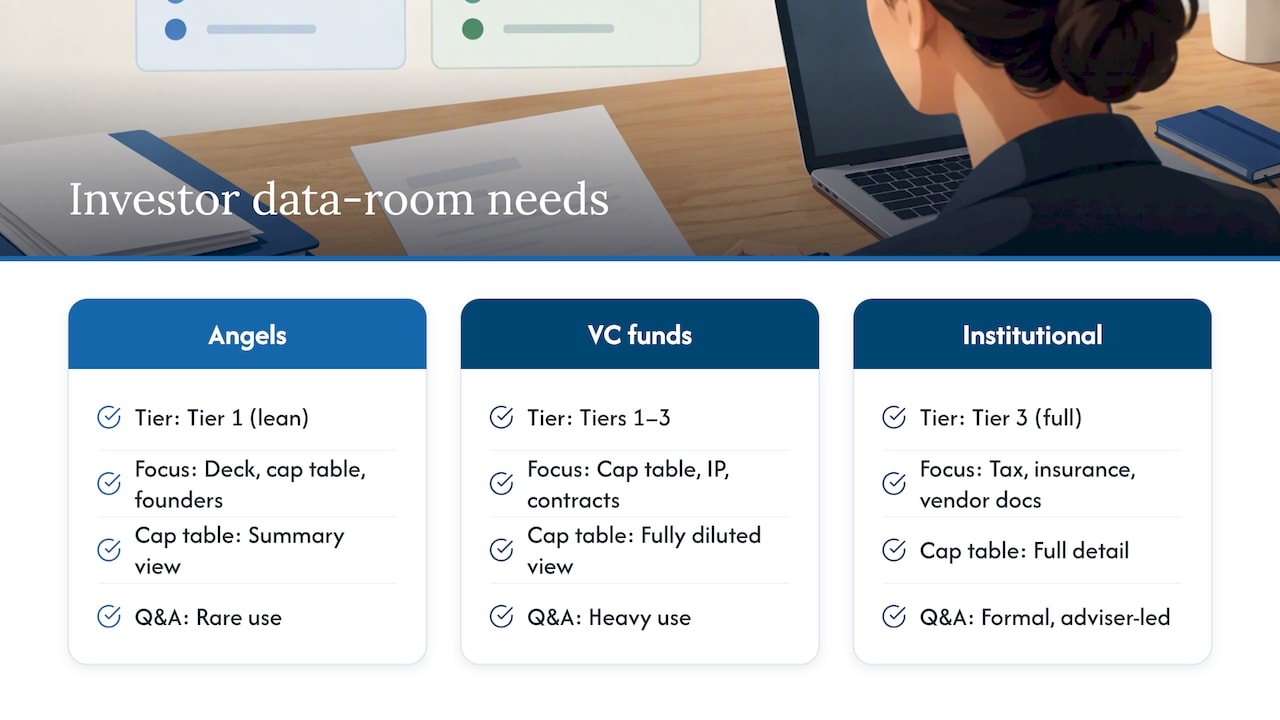
Angel investors, often writing smaller cheques at pre-seed or seed stage, tend to focus on the deck, cap table and founder story more than deep legal detail. A lean Tier 1 room with a clear “Read me first” index usually satisfies most of their questions without needing the full Tier 2 and Tier 3 build-out.
Venture capital funds generally push through all three tiers, with particular attention to the cap table’s fully diluted picture, IP assignment and any material contracts that could affect scalability. They are also the group most likely to use the Q&A module heavily rather than asking questions by e-mail.
Institutional investors, including those involved in later rounds or structured processes, expect the full Tier 3 build: tax returns, detailed insurance schedules and vendor contract detail, often reviewed by their own legal and financial advisers rather than the investment team alone. Building the room to Tier 3 standard from the outset, even if earlier investors never request it, means a later round does not require rebuilding the room from scratch.
Legal and compliance risks beyond local rules
A data room built only around local law can create problems the moment an investor or acquirer sits outside that jurisdiction. Several risks are worth checking before a room goes live.
Where a US-based investor or fund is involved, be aware that materials shared during a fundraising process can carry securities law implications under SEC rules, particularly around what claims are made in a deck or financial projection. This is a legal question for counsel rather than something a data room’s technical settings can resolve, but it affects how forward-looking statements should be worded.
GDPR implications run in the other direction: if the data room provider or any investor reviewing it processes personal data of EU individuals, such as employee records in an HR folder, a signed Data Processing Agreement and clarity on where that data is stored matter regardless of where the company itself is based. Compliance guidance for regulated sectors is explicit that a certified provider does not remove this obligation; the founder still needs the DPA in place and the data residency question answered before sensitive personal data goes into the room.
Export controls, sanctions screening and sector-specific licensing requirements can also apply depending on the business and the investor’s own jurisdiction, and these are worth a specific check with legal counsel rather than an assumption that a data room’s permission settings handle them automatically.
Author perspective: practical priorities for founders versus fund managers
Founders tend to over-invest in the deck and under-invest in the boring parts: cap table accuracy, SEIS/EIS paperwork, and whether board minutes actually match what the company filed at Companies House. Investors rarely say this is what they are checking, but it is usually the first thing their own finance team flags.
Fund managers, by contrast, care less about polish and more about whether the numbers reconcile and whether material contracts hold up under their own audit trail. A short joint checklist, cap table matches filings, SEIS/EIS documents are complete, and the room’s audit log shows nothing unusual, closes most of the gap between what founders prepare and what investors actually need.
— Rahamut
How Price & Accountants can help
Building the room is only half the job. The accounting and compliance detail inside it, cap table reconciliation, SEIS/EIS packs, management accounts that match what you have told investors verbally, is where rounds actually stall. Price & Accountants works alongside tech and fintech founders from pre-seed through Series A to get that detail right before investors start asking questions, drawing on SEIS and EIS scheme expertise and outsourced finance director support rather than a generalist’s checklist.
Services map directly onto data room tasks: Bookkeeping & Accounting and Company Accounts keep your management accounts current, Advisory & Tax Planning covers SEIS/EIS pack preparation, and Finance directorship services provide the senior sign-off investors expect to see behind the numbers. The result founders report most often is fewer follow-up queries and faster investor sign-off once the room goes live.
Explore plans and pricing on the Price & Accountants pricing page, including the Core Services, Blue Plan and Black Plan options, to find the right level of support for your next round.
Sources
For the UK-specific checklist and investor guidance referenced throughout this article, see the GOV.UK data room essentials guide. For technical security requirements including encryption, authentication and certification standards, see the VDR security features guide. For UK fundraising document specifics including SEIS/EIS paperwork, see the investor-ready data room guide. For a broader view on privacy-first data sharing concepts relevant to how information is handled across platforms, see this piece on data clean rooms.
- Gov
- VDR security features: the complete guide - Euronext Corporate Solutions
- Investor-ready data room guide for UK startups - Undo Capital
FAQ
What is an investor data room?
An investor data room is a secure, permission-controlled online repository where a company shares financial, legal and commercial documents with investors during fundraising due diligence. It typically includes a cap table, management accounts, incorporation documents and legal agreements, organised into tiers that match how investors request information.
Which data room is best for investors?
There is no single best platform; the right choice depends on round size and complexity. For most fundraising rounds, look for a provider offering per-recipient access controls, a structured Q&A module, dynamic watermarking and a full audit trail, alongside ISO 27001 and SOC 2 Type II certification.
What is a data room in investment banking?
In investment banking, a data room is the same secure repository concept applied to larger transactions such as mergers, acquisitions or institutional capital raises, usually holding a far larger volume of legal, financial and commercial documents than an early-stage fundraising room. The structure and security requirements are similar, but the review process typically involves more parties and a longer diligence timeline.
How much does a data room cost?
Costs vary by provider and round size, and pricing is generally available on request from the platform rather than published as a flat rate. Accounting and compliance support to prepare the documents inside the room, such as the services listed on the Price & Accountants services page, is priced separately from the data room software itself.
What should founders include in a UK fundraising data room?
A UK fundraising room should cover Tier 1 items such as the deck, cap table and management accounts, Tier 2 items like board minutes and material contracts, and UK-specific paperwork including SEIS/EIS advance assurance and SEIS1/EIS1 submissions. Reconciling the cap table against Companies House SH01 filings before the room goes live avoids one of the most common causes of delay.