

TL;DR:
- Missing tax relief opportunities can severely limit startup capital and growth potential.
- Proper structuring, eligibility checks, and timely HMRC assurances are crucial for maximizing reliefs.
- Tax efficiency should be viewed as a strategic growth tool, not just compliance.
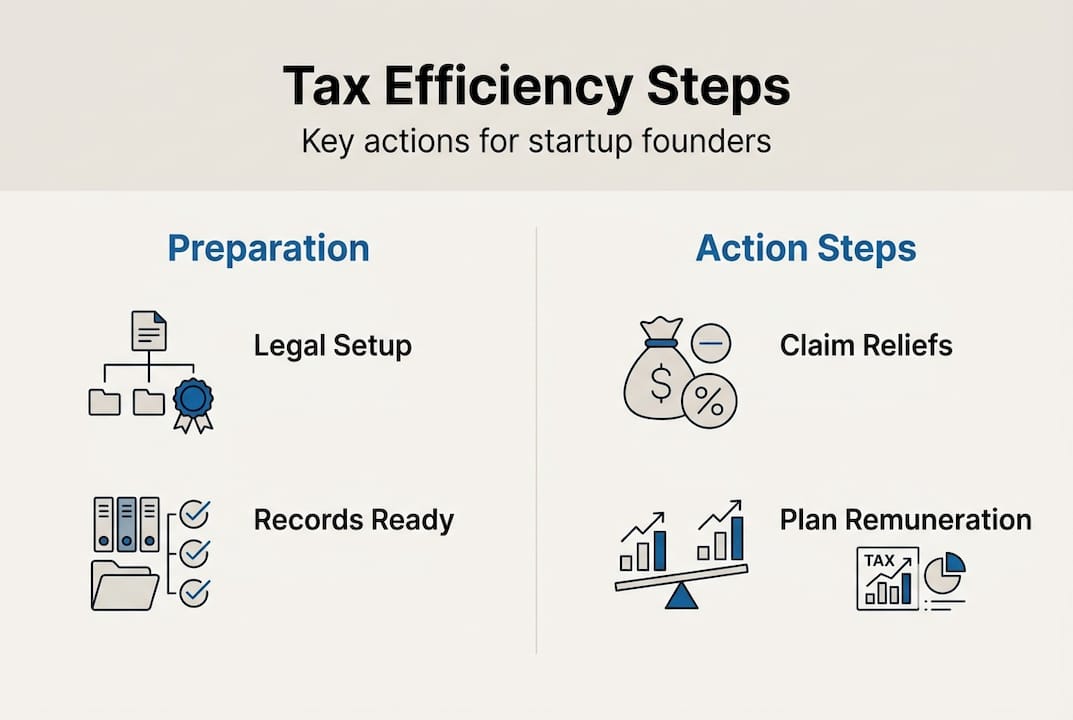
Missing a single tax relief can cost your startup tens of thousands of pounds in capital you could have reinvested into growth. Many tech and fintech founders treat tax as an afterthought, filing returns at the last minute and leaving SEIS, EIS, and R&D credits unclaimed. The result is not just a higher tax bill; it is a direct reduction in your runway. This guide walks you through a structured, step-by-step approach to building genuine tax efficiency into your company from the ground up, covering everything from your initial company setup through to remuneration strategy and annual compliance reviews.
Table of Contents
- Assessing your startup’s tax position: Key prerequisites
- Sequencing SEIS and EIS: Maximising investment and relief
- Unlocking R&D tax reliefs: Claiming and maximising innovation credits
- Founder remuneration: Dividend, salary, and bonus strategies
- Common pitfalls and how to verify your tax efficiency
- Our view: Why tax efficiency is your growth lever, not just compliance
- Start optimising your tax position with expert support
- Frequently asked questions
Key Takeaways
PointDetailsUse the right legal structureA UK limited company is essential to unlock SEIS, EIS, and R&D tax reliefs.Sequence SEIS and EIS effectivelyPlan funding rounds to first access SEIS benefits, then scale up using EIS.Claim all eligible R&D creditsTake full advantage of recent R&D tax relief rates to maximise innovation funding.Mix salary and dividendsStructuring your own remuneration smartly can significantly reduce your personal tax bill.Review tax efficiency each yearRegularly check your structures and claims to maintain and improve savings.
Assessing your startup’s tax position: Key prerequisites
Before you can benefit from any specific relief, you need to know exactly where your company stands. Think of this as a pre-flight check. Skipping it means you might pitch investors on SEIS eligibility you do not actually have, or miss an R&D claim because your documentation is incomplete.
The single most important structural decision is operating as a UK limited company. As outlined in the startup tax planning checklist, structuring as a UK limited company is what unlocks access to SEIS, EIS, and R&D reliefs, and it also allows founders to combine salary and dividends for personal tax efficiency. Sole trader or partnership structures simply do not qualify.
Once your structure is confirmed, run an eligibility check across three areas:
- Company age and assets: SEIS requires the company to be under three years old with gross assets of £350,000 or less. EIS allows up to seven years and £15 million in gross assets.
- Employee headcount: SEIS caps at fewer than 25 full-time employees; EIS at fewer than 250.
- Trade type: Both schemes exclude certain trades, including financial services, property, and legal work.
Your key documents should be organised and accessible at all times. These include your incorporation certificate, shareholder register, latest management accounts, and any existing HMRC correspondence. A well-organised startup tax workflow will save you hours when deadlines arrive.
DocumentWhy it mattersIncorporation certificateConfirms company age for SEIS/EISShareholder registerRequired for advance assurance applicationsManagement accountsEvidences gross assets and R&D spendHMRC correspondenceTracks prior claims and compliance history
Pro Tip: Set up a cloud-based folder structure from day one, organised by tax year, with subfolders for SEIS/EIS, R&D, payroll, and VAT. This takes 20 minutes to create and saves you days of scrambling later.
Sequencing SEIS and EIS: Maximising investment and relief
With your prerequisites confirmed, the next step is structuring your funding rounds to maximise the reliefs available to your investors. The order matters enormously here.
SEIS is your pre-seed tool. Under the current rules, SEIS gives investors 50% income tax relief on investments up to £200,000 per tax year, for companies under three years old with gross assets of £350,000 or less, fewer than 25 employees, and a maximum lifetime raise of £250,000. That 50% relief is extraordinarily attractive to early investors; it effectively halves their downside risk on day one.

Once you have exhausted your SEIS allowance, you move to EIS. EIS provides 30% income tax relief on investments up to £1 million per investor per tax year, rising to £2 million for knowledge-intensive companies. Your company must be under seven years old, have gross assets of £15 million or less, and fewer than 250 employees, with an annual raise limit of £5 million.
FeatureSEISEISInvestor income tax relief50%30% (up to 60% for KIC)Max company raise£250,000 lifetime£5m per yearCompany age limitUnder 3 yearsUnder 7 yearsGross assets limit£350,000£15 millionMax employees25250
Here is the step-by-step sequence to follow:
- Confirm eligibility using the prerequisites checklist above.
- Apply to HMRC for advance assurance before you pitch a single investor.
- Complete your SEIS raise fully before issuing any EIS shares.
- Apply for a new advance assurance for your EIS round.
- Issue EIS compliance statements to investors after the round closes.
For deeper guidance on structuring these rounds, the SEIS/EIS success strategies resource covers share class structuring and investor communications in detail. You can also review practical SEIS/EIS investment sequencing examples from real funding rounds.
Pro Tip: Never run SEIS and EIS raises simultaneously. Overlapping them invalidates both sets of relief and can destroy investor confidence at the worst possible moment.
Unlocking R&D tax reliefs: Claiming and maximising innovation credits
Once your funding structure is in place, R&D tax relief is often the single largest cash injection available to an early-stage tech or fintech company. Yet it remains one of the most underclaimed reliefs in the UK.
From April 2024, the previous SME and RDEC schemes merged into a single framework. Under the merged R&D scheme, most companies receive a 15 to 16% credit on qualifying expenditure. R&D-intensive SMEs spending 30% or more of their total costs on R&D qualify for the Enhanced R&D Intensive Support (ERIS) rate of up to 27%. Total UK R&D claims reached £7.6 billion in 2023/24, yet many eligible startups still do not claim.
“The most expensive R&D claim is the one you never make. UK businesses left significant capital on the table in 2023/24 simply through inaction.”
To claim successfully, follow this process:
- Identify qualifying projects: Work must seek to advance science or technology and involve genuine technical uncertainty.
- Calculate qualifying costs: Include staff costs, subcontractors, software, consumables, and cloud computing costs directly linked to R&D.
- Prepare technical and financial documentation: HMRC now requires a detailed Additional Information Form submitted before your Corporation Tax return.
- Submit within two years of your accounting period end: Missing this deadline means losing the claim entirely.
Cost categoryQualifies?Staff salaries (R&D time)YesSubcontractor costsPartial (65% for unconnected parties)Cloud computing and softwareYes (from April 2023)General overheadsNo
For practical R&D compliance tips and a broader view of tax planning strategies that complement R&D claims, these resources are worth reviewing before you submit.
Founder remuneration: Dividend, salary, and bonus strategies
External reliefs secured, the next lever is internal: how you structure your own pay. Getting this wrong is surprisingly common, and the cost is real.
As a director of a UK limited company, you have flexibility that employees simply do not. The most tax-efficient approach, as highlighted in the startup tax planning checklist, is to combine a modest salary with dividends. Here is why each element matters:
- Salary up to the National Insurance threshold: This preserves your state pension entitlement without triggering significant National Insurance Contributions (NICs). For 2026, this sits around the lower earnings limit.
- Dividends above the salary: Dividends are taxed at lower rates than salary (8.75%, 33.75%, or 39.35% depending on your tax band) and carry no NICs for either you or the company.
- Bonuses: Useful for one-off performance events, but they attract full income tax and NICs, so they are rarely the most efficient default option.
The pitfalls founders most commonly hit include:
- Paying a salary well above the NIC threshold without a strategic reason.
- Declaring dividends when the company has insufficient distributable reserves, which creates an overdrawn director’s loan account.
- Ignoring investor expectations: some funding agreements restrict founder remuneration, and breaching these can affect your SEIS/EIS compliance.
For a fuller breakdown of the financial decisions behind scaling, the accounting tips for founders guide covers remuneration planning alongside cash flow and Series A preparation.
Pro Tip: Review your remuneration structure at the start of every tax year, not at year-end. Aligning pay decisions with your growth milestones and investor reporting periods avoids nasty surprises and keeps your compliance clean.
Common pitfalls and how to verify your tax efficiency
Even founders who start well can drift into inefficiency. The most damaging mistakes are rarely dramatic; they are quiet, cumulative errors that compound over time.
“Advance assurance is not optional. It is the single step that separates fundable companies from those that lose investors at due diligence.”
The step-by-step tax planning guide is clear: sequence SEIS before EIS and secure HMRC advance assurance before pitching. Skipping advance assurance is the most common and most costly mistake we see.
Here is an annual verification checklist every founder should run:
- Confirm your company still meets SEIS or EIS eligibility criteria.
- Check that all R&D claims have been submitted within the two-year window.
- Review your shareholder register for any changes that could affect scheme compliance.
- Verify that dividends declared are covered by distributable reserves.
- Confirm your remuneration structure still reflects current tax thresholds.
Common issues to troubleshoot:
- Missed advance assurance: Apply retrospectively if possible; otherwise, seek specialist advice before approaching investors.
- R&D claim rejected: Review the technical narrative and cost methodology; HMRC rejections are often due to insufficient documentation rather than ineligible activity.
- Overdrawn director’s loan: Repay within nine months of the accounting year-end to avoid a 33.75% Section 455 tax charge.
For situations where complexity is mounting, working with a specialist tax consultant can prevent small errors from becoming expensive HMRC enquiries.
Our view: Why tax efficiency is your growth lever, not just compliance
Most founders we speak to treat tax planning as a defensive exercise: something to get right so nothing goes wrong. That framing is understandable, but it is also limiting.
The founders who reach Series A in the strongest position are almost always those who started tax planning at pre-seed. Not because they saved a few thousand pounds in corporation tax, but because their SEIS structure was clean, their R&D claims were credible, and their cap table told a coherent story to investors. Tax efficiency, done well, is a fundraising asset.
We have seen founders lose investor interest not because their product was weak, but because their SEIS advance assurance had lapsed or their R&D claim was under HMRC enquiry. These are avoidable problems. Understanding why tax planning matters at the strategic level, not just the compliance level, is what separates founders who scale from those who stall.
Treat tax efficiency as a top-three growth tool alongside product and hiring. The returns are measurable and the risks of inaction are real.
Start optimising your tax position with expert support
The strategies in this guide are actionable, but the detail matters enormously. A small error in your SEIS structure or R&D claim can cost you far more than the cost of getting expert support from the outset.

At Price & Accountants, we work with tech and fintech founders from pre-seed through Series A, providing bespoke tax strategies, R&D tax credits claims management, and advisory tax planning that goes well beyond standard compliance. Whether you need a full tax efficiency review, help securing HMRC advance assurance, or an outsourced finance director to guide your next funding round, our team is ready. Visit Price & Accountants to find out how we can support your growth.
Frequently asked questions
Who qualifies for SEIS and EIS tax reliefs as a founder?
Your company must be a UK limited company meeting the relevant criteria on age, gross assets, and employee count. For SEIS, the company must be under 3 years old with gross assets of £350,000 or less, while EIS allows up to 7 years and £15 million in gross assets.
What records do I need to claim R&D tax credits?
You will need detailed project descriptions, a breakdown of qualifying R&D expenditure, and evidence of the scientific or technical uncertainty your work addressed. Since April 2023, HMRC also requires an Additional Information Form submitted before your Corporation Tax return, as part of the merged R&D scheme requirements.
Is it better for founders to take salary or dividends?
A combination of a modest salary and dividends typically delivers the best tax outcome, reducing NICs whilst making use of lower dividend tax rates. The right split depends on your company’s distributable reserves, funding agreements, and personal tax position, as outlined in the salary and dividend guidance.
When should I apply for SEIS/EIS advance assurance?
Always apply before pitching to investors or agreeing any terms. The advance assurance process gives investors confidence that their relief will be valid, and skipping it is one of the most common reasons early-stage deals fall through at due diligence.
Recommended
- Tax efficiency for UK tech founders: SEIS/EIS success - Price & Accountants
- Director Tax Planning Strategies for Tech Founders - Price & Accountants
- Optimise your UK startup tax planning workflow in 2026 - Price & Accountants
- Step-by-step tax planning guide for UK startups 2026 - Price & Accountants
- Rental Income Tax Tips: Complete Guide for SA Landlords - Rental Income Insurance