

You can normally claim staff costs, subcontractor and externally provided worker (EPW) payments, consumables and prototypes, software, data licences, certain cloud computing costs, and clinical trial participant payments as qualifying R&D expenditure. These now sit under the merged RDEC scheme or Enhanced R&D Intensive Support (ERIS), following the April 2024 reforms and tighter overseas spending rules. Getting the apportionment and evidence right is what decides whether a claim survives HMRC scrutiny.
TL;DR:
- Staff costs must be directly attributable to R&D work, with contemporaneous timesheets or project codes providing the strongest evidence for apportionment.
- Payments to overseas contractors and EPWs are generally excluded from qualifying costs under the 2024 reforms unless there is a clear environmental or geographic necessity.
- Cloud computing and data licences qualify as R&D expenditure if usage logs, resource tagging, or billing splits demonstrate direct contribution to resolving scientific or technological uncertainty.
- Proper documentation, contract clarity, and consistent apportionment methods are crucial for defending claims during HMRC scrutiny, especially for subcontractor and indirect activities.
- The combination of the merged RDEC scheme and ERIS depends heavily on accurate cost categorization, as errors can affect eligibility for the most beneficial tax relief schemes starting April 2024.
Table of Contents
- Overview: categories of qualifying R&D expenditure
- Staff costs: what you can claim and how to apportion time
- Subcontracted R&D and externally provided workers (EPWs): rules and percentages
- Consumables and prototypes: what counts as used up in R&D
- Software, data licences and cloud computing: recent rules and evidence needed
- Qualifying indirect activities (QIAs) and how to allocate and support them
- Overseas expenditure: current UK restrictions and limited exceptions
- Costs you cannot claim (quick reference)
- Practical checklist: how to identify and record eligible costs for an HMRC claim
- Impact of recent legislative changes on R&D eligible costs beyond software and cloud computing
- Detailed explanation of apportionment methodologies and best practices for time tracking
- Guidance on collaborative R&D projects and how costs are allocated among participants
- Author perspective: how Price & Accountants helps clients avoid common pitfalls
- How Price & Accountants can help with an R&D claim
- FAQ
- Sources
Overview: categories of qualifying R&D expenditure
HMRC groups qualifying costs into distinct buckets, and understanding which bucket your spend falls into is the first job before you touch a claim form. Each category carries its own rules on apportionment and evidence, but they share one test: the cost must be revenue expenditure connected to resolving genuine scientific or technological uncertainty, not capital spend on assets you will keep using afterwards.
That revenue versus capital distinction matters because a capitalised asset, such as owned server infrastructure you built from scratch, generally falls outside the costs you can claim, even though data licences and cloud computing costs themselves have been in scope since April 2023.
The main categories are:
- Staff costs: salaries, employer National Insurance contributions and pension contributions for employees directly engaged in R&D.
- Subcontracted R&D and EPWs: payments to contractors or staff supplied through an agency, apportioned under specific statutory rules.
- Consumables and prototypes: materials, power and fuel used up in the R&D process.
- Software, data licences and cloud computing: subscriptions and usage fees tied to resolving technical uncertainty.
- Clinical trial payments: payments made to volunteers participating in clinical trials.
Each is expanded below, with the apportionment method and the records HMRC expects to see.
Staff costs: what you can claim and how to apportion time
Staff costs are usually the largest line in an R&D claim, and they are also the most heavily scrutinised. Eligible pay elements include gross salary, employer NICs, employer pension contributions, and reimbursed expenses directly tied to R&D work. Certain training costs can qualify when the training is specifically for staff carrying out the R&D itself, but general management time and administrative overheads sit outside the claim unless they fall under qualifying indirect activities.
The practical challenge is apportioning a person’s time between R&D and non-R&D work when they rarely do only one or the other.
- Timesheets recorded weekly or monthly against project codes give the strongest evidence.
- Project coding within existing payroll or project management software lets you pull apportionment percentages directly from the system.
- Reasonable estimates are acceptable when backed by a documented rationale, such as a manager’s sign-off explaining how the percentage was derived.
Contemporaneous records, even informal ones kept monthly, carry far more weight than a retrospective estimate built at claim time.
Pro Tip: Build your time-tracking habit into the accounting period itself, not at claim preparation stage: a contemporaneous log beats a reconstructed estimate every time HMRC asks for evidence.
Subcontracted R&D and externally provided workers (EPWs): rules and percentages
The distinction between contracted-out R&D and an EPW arrangement determines who can actually claim the cost, and HMRC treats this as a statutory test rather than a matter of preference. A contractor who delivers an outcome, such as a software house building a defined technical solution to your specification, is typically contracted-out R&D. A worker supplied through an agency to sit inside your team and follow your direction is an EPW.
Only the company that made the decision that R&D needed to be carried out, and which directs and bears the risk of that R&D, can claim the related costs, as HMRC’s guidance makes clear.
- Payments to unconnected subcontractors are typically apportioned at a proportion of the amount paid.
- Payments to connected parties use the lower of the amount paid or the subcontractor’s own relevant costs.
- EPW costs generally require the worker’s earnings to pass through the PAYE and NIC system, acting as a gateway to qualifying status.
Keep the original contract, correspondence showing who directed the work, and a breakdown of mixed deliverables where only part of a contractor’s output related to R&D. Our guide to R&D subcontractor costs walks through apportionment examples in more detail.
Pro Tip: Review every subcontractor and agency contract before you claim: a vague scope of work is one of the fastest routes to an EPW versus contracted-out dispute with HMRC.
Consumables and prototypes: what counts as used up in R&D
Consumable items are materials and utilities genuinely used up during the R&D process rather than retained afterwards. Claimable examples include raw materials, chemicals, prototype components, power and fuel consumed while testing or building a prototype.
- Materials physically transformed or destroyed during testing.
- Power, water and fuel apportioned to the time and output of R&D activity.
- Prototype parts that do not survive the R&D process in a saleable state.
The grey area sits where a prototype moves from R&D testing into something sold or used commercially. If a prototype batch is later sold as finished stock, that portion of the cost shifts into routine production and stops qualifying. Keep batch records showing what proportion of a production run was scrapped, tested to destruction, or retained as the first commercial unit, since this split is exactly what an HMRC enquiry will ask you to justify.
Software, data licences and cloud computing: recent rules and evidence needed
Licence fees, subscriptions and cloud computing costs can be qualifying revenue expenditure, and since 1 April 2023 this scope was extended specifically to include data licences and cloud computing services where they directly contribute to resolving scientific or technological uncertainty. What does not qualify is the capital cost of setting up owned infrastructure, such as building and configuring your own data centre, which HMRC treats as capital expenditure outside this category.
- Usage logs showing which cloud instances or compute hours relate to R&D workloads.
- Resource tagging within your cloud provider’s console to separate R&D spend from production hosting.
- Billing splits from invoices, itemising R&D-related services against day-to-day operational use.
Generic business software, such as accounting packages or general office subscriptions, will not qualify unless you can show it was demonstrably used to resolve a specific technical uncertainty, which is rarely the case for off-the-shelf tools. Our glossary entry on cloud accounting software explains how this differs from R&D-qualifying cloud infrastructure.
Pro Tip: Tag cloud resources by project from day one: retrofitting a billing split months later is far harder than exporting a tagged usage report when HMRC asks.
Qualifying indirect activities (QIAs) and how to allocate and support them
Qualifying indirect activities are costs that support the R&D project without being part of the core experimental work itself, and HMRC treats this category narrowly. Examples include maintenance and security of premises or equipment used for R&D, and certain administrative functions specifically tied to the project, such as scientific administration.
- Identify the activity: confirm it genuinely supports the R&D rather than the business generally.
- Choose an apportionment key: floor space, headcount or time spent are common cost drivers.
- Document the rationale: record why that key was chosen and how the percentage was calculated.
- Retain evidence: keep invoices, facility schedules and any usage logs behind the apportionment.
The Additional Information form guidance warns that weak QIA evidence, particularly where a claim cross-references an external technical report without explaining the detail directly, is a common trigger for HMRC challenge. Treat QIAs as the category needing the clearest paper trail, not the one where estimates are loosest.
Overseas expenditure: current UK restrictions and limited exceptions
Since April 2024, payments to overseas contractors and for overseas EPWs are generally excluded from qualifying expenditure under both the merged RDEC scheme and ERIS. This restriction affects subcontracted R&D and EPW costs specifically, rather than consumables or software licences bought from overseas suppliers.
A narrow set of exceptions can still permit overseas costs to qualify, where the conditions needed for the R&D are not present in the UK, where there is a genuine environmental or geographic necessity, or where replicating the work in the UK would be wholly unreasonable.
- Written evidence explaining the specific UK limitation, whether technical, environmental or regulatory.
- Confirmation that cost or worker availability alone was not the deciding factor.
- Documentation showing when and why the overseas location was chosen, contemporaneous with the decision.
HMRC will scrutinise exactly this point, so cost-driven overseas sourcing on its own will not meet the exception.
Costs you cannot claim (quick reference)
Several cost types are excluded outright, regardless of how closely they sit next to genuine R&D work.
- Capital expenditure, including owned equipment, buildings and infrastructure set-up.
- Land and costs connected with acquiring or improving it.
- Patents and trademarks, including registration and ongoing protection costs.
- Routine production and distribution, once a product or process has moved past the experimental stage.
- Rent and rates on premises, even where R&D activity takes place there.
Some costs that feel connected to R&D still fall outside scope because they are a business cost rather than an experimental one, for example general management oversight or standard IT support unrelated to resolving technical uncertainty. When in doubt, ask whether the cost would exist even if no R&D were taking place.
Practical checklist: how to identify and record eligible costs for an HMRC claim
Preparing a robust claim is a sequencing exercise as much as a technical one.
- Align costs to the accounting period your claim covers, matching the accounting period used in your statutory accounts.
- Extract staff and project time from timesheets or project codes for everyone involved.
- Collate supplier invoices for subcontractors, EPWs, consumables, software and cloud services.
- Document the allocation method and rationale for every apportioned cost.
- Draft a concise technical narrative linking the costs to the specific uncertainty resolved.
Keep timesheets, tagged invoices, cloud usage logs, subcontractor contracts and evidence showing who made the decision to carry out the R&D. Our article on getting the claim process right sets out the Additional Information form requirements in full.
Pro Tip: Build a simple cost-bucket table from your accounts before you start drafting: staff, subcontractors, EPWs, consumables, software and cloud, each with its own apportionment column.
Impact of recent legislative changes on R&D eligible costs beyond software and cloud computing
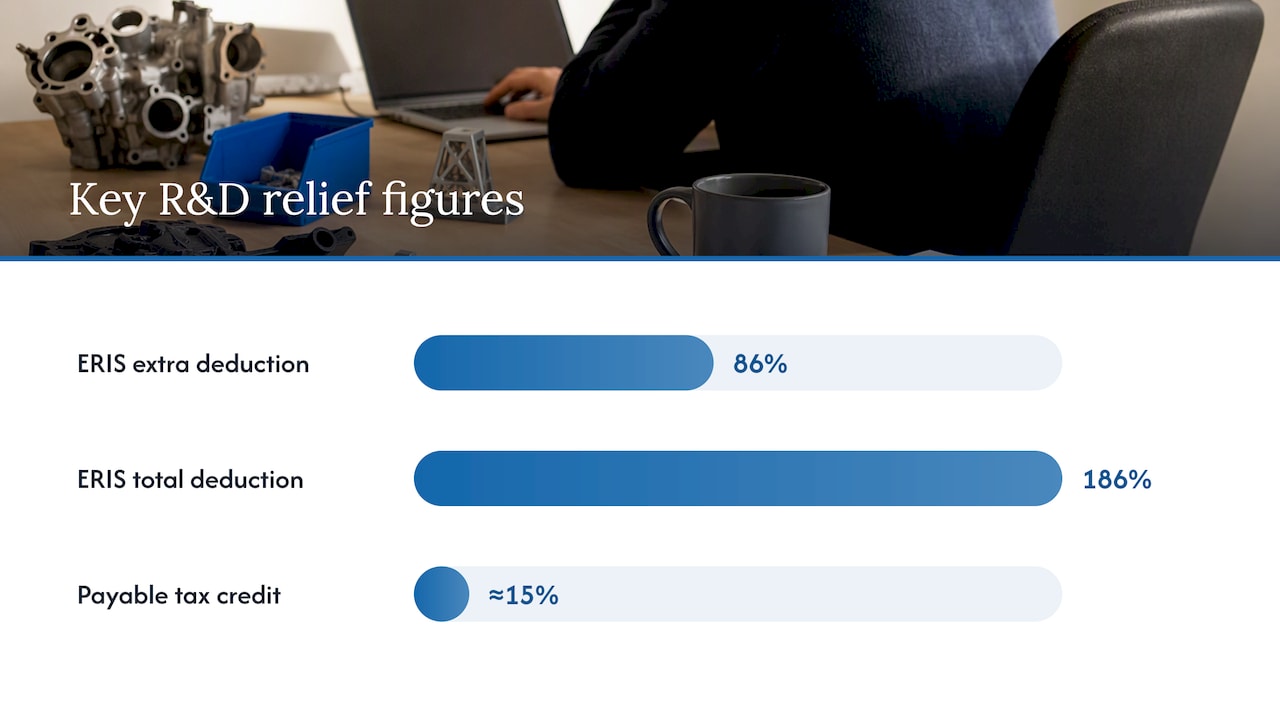
The April 2024 reforms reached well beyond cloud and software rules, reshaping how most SMEs calculate and claim relief at all. The previous separate SME scheme and RDEC scheme have been replaced by a single merged RDEC scheme offering a credit rate for the merged RDEC scheme, alongside ERIS for qualifying loss-making R&D-intensive SMEs, which provides an extra 86% deduction, a total of 186%, and a payable tax credit at just under fifteen percent, as set out in HMRC’s internal manual. Eligibility for ERIS depends on meeting a threshold for qualifying R&D intensity that claimants must meet beginning April 2024 for accounting periods beginning on or after 1 April 2024.
This restructuring changes the practical stakes of getting cost categorisation right. Under the merged scheme, the credit is taxable and calculated centrally, which means an error in your qualifying expenditure figure flows straight through to your tax computation rather than sitting in a separate relief calculation. For R&D-intensive loss-making companies weighing ERIS against the merged scheme, the intensity threshold itself depends on an accurate total expenditure figure, so getting staff, subcontractor and consumable costs right is no longer just about claim size, it can determine which scheme you qualify for at all.
The contracting-out rules introduced alongside the merged scheme also redrew who can claim contracted-out R&D costs, shifting the claiming right towards the company that initiated and directed the R&D rather than the one simply paid to perform it. Our 90 day action plan for merged scheme compliance covers the practical steps for aligning your accounts to these changes.
Detailed explanation of apportionment methodologies and best practices for time tracking
Apportionment is the single area where claims are won or lost on evidence quality rather than eligibility in principle. Three broad methodologies apply across the cost categories: timesheet-based tracking, project-code allocation within existing systems, and reasonable estimation backed by documented rationale.
Timesheet-based tracking offers the strongest evidence because it is contemporaneous and specific to the individual and the task. The practical weakness is adoption: staff rarely fill in timesheets consistently unless the habit is built into existing workflows, such as linking time entries to sprint boards or project management tools already in use.
Project-code allocation works well where a business already runs time or cost tracking through accounting or project software, since the apportionment percentage can be extracted directly rather than estimated after the fact. This method scales better across larger teams and reduces the administrative burden of a separate R&D timesheet process.
Reasonable estimation remains acceptable, but only where the rationale is documented at the time, not reconstructed months later for the claim.
Whichever method you choose, consistency matters more than precision. Switching methodologies between accounting periods without explanation is a common flag in HMRC enquiries, so document the method chosen, apply it consistently, and only change it where the underlying work genuinely changes shape.
Guidance on collaborative R&D projects and how costs are allocated among participants
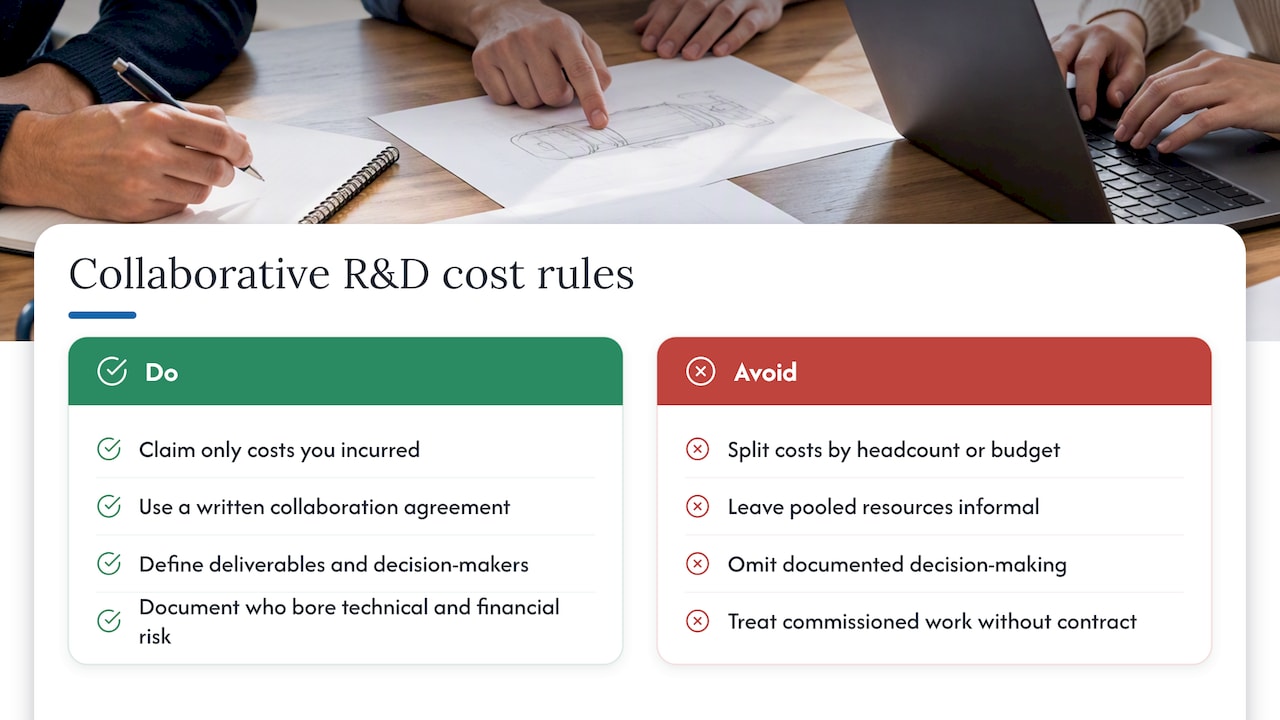
Collaborative R&D, where two or more companies work together on a shared technical challenge, raises a specific question: which party can claim which costs. The starting point is the same decision-maker test that applies to subcontracted R&D generally, the company that decided the R&D needed to be undertaken, directed its course and bore the financial risk is the one entitled to claim the related expenditure.
In a genuine collaboration, this often means each participant claims only the costs it directly incurred and controlled, rather than splitting a shared pot by headcount or budget share. If one party commissions specific work from the other under a contract, that arrangement is assessed under the same contracted-out or EPW rules covered earlier, with the commissioning party typically holding the claiming right subject to the connected party and apportionment rules.
Where companies pool resources informally, without a clear contractual allocation of risk and direction, HMRC is likely to ask harder questions about who was actually driving the R&D. Clear contracts, defined deliverables and documented decision-making are just as important in a collaborative structure as in a straightforward subcontractor relationship, arguably more so, because the absence of a formal supplier relationship can obscure who bore the technical and financial risk.
Keep a written collaboration agreement that sets out each party’s contribution, the technical uncertainty each is addressing, and how costs and any resulting intellectual property are shared. This becomes the primary evidence HMRC will ask for if a joint claim is queried.
Author perspective: how Price & Accountants helps clients avoid common pitfalls
The most frequent errors we see are poor apportionment evidence, thin documentation for qualifying indirect activities, and EPW arrangements misclassified as contracted-out R&D, or the reverse. Each of these is avoidable with the right structure in place before the accounting period even closes.
We build allocation templates tailored to existing systems, whether that means pulling time data from project management tools or structuring a simple monthly sign-off process for technical staff. We then use that evidence to draft the Additional Information form with technical and financial detail to support the claim, rather than relying on a generic narrative. Our R&D tax credit service page sets out how this fits into a wider claim engagement.
— Rahamut
How Price & Accountants can help with an R&D claim

We review qualifying costs, build the apportionment workings for staff, subcontractors, EPWs and cloud spend, and draft the Additional Information form required alongside the claim. This work aims to provide defensible figures before submission rather than adjustments after enquiry. Visit our R&D tax credit service page to arrange an initial review of your current claim approach.
FAQ
What counts as an eligible R&D cost under UK rules?
Eligible costs typically include staff pay and employer NICs, subcontracted R&D and EPW payments, consumables and prototypes, software, data licences and certain cloud computing services, and clinical trial participant payments, as set out in HMRC’s guidance. Each category has its own apportionment rules, and the cost must be revenue rather than capital expenditure.
How do you apportion staff time for an R&D claim?
Timesheets or project codes tracked against R&D work give the strongest evidence, while reasonable estimates are acceptable when backed by a documented rationale recorded at the time. Avoid round, unexplained percentages applied uniformly across a technical team, since these commonly draw HMRC queries.
Can overseas subcontractor costs still qualify for R&D relief?
Generally no, since payments to overseas contractors and EPWs were restricted from qualifying expenditure under the post-2024 rules. A narrow exception applies where conditions needed for the R&D are not present in the UK, or where replicating the work in the UK would be wholly unreasonable, but cost alone does not meet this test.
Are cloud computing and software subscription costs eligible?
Yes, data licences and cloud computing costs have qualified as revenue expenditure since 1 April 2023 where they directly support resolving a technical uncertainty, but capital costs of building owned infrastructure do not qualify. Usage logs, resource tagging and billing splits are the practical evidence HMRC expects to see.
What is the difference between the merged RDEC scheme and ERIS?
The merged RDEC scheme applies a credit rate for the merged RDEC scheme rate for most claimants, while ERIS offers an extra 86% deduction, a total of 186%, plus a payable tax credit at just under fifteen percent for qualifying loss-making R&D-intensive SMEs meeting an intensity threshold beginning April 2024, as documented in HMRC’s internal manual. Both apply to accounting periods beginning on or after 1 April 2024.