

Scenario planning in finance is the discipline of modelling several plausible futures, rather than one forecast, so leadership teams can decide in advance how they will react. It matters most when cash runway is tight, a fundraise is approaching, or the market is shifting fast. Done well, it shortens decision cycles and gives a board confidence that management has already thought through the downside.
TL;DR:
- Scenario planning should include at least two years of historic data and five years of forecast, with assumptions clearly logged and sensitivity tested.
- Models must connect directly to cash forecasts with predefined triggers, such as a specific cash threshold, to enable operational decision-making.
- Use deterministic, stochastic, or stress models based on the company’s complexity and funding timeline, ensuring simplicity for board presentations.
- Avoid overly complex models with hidden formulas or unlabelled assumptions, focusing instead on coherence and clear narrative for decision triggers.
- Integrate scenario variables into risk management frameworks by updating risk registers and linking material risks to scenario outcomes.
Table of Contents
- What scenario planning is and why it matters to finance teams
- A practical, step-by-step scenario planning process
- Modelling approaches: deterministic, stochastic and stress methods explained
- Practical modelling guidance and deliverables for finance teams
- How scenario planning ties to cash forecasting and runway decisions
- Presenting scenarios and decision rules to the board
- Common pitfalls and a checklist to avoid them
- How Price & Accountants applies scenario planning in practice
- Integration of scenario planning with risk management frameworks
- Software tools and technologies commonly used for scenario planning in finance
- A finance leader’s take on scenario planning
- How Price & Accountants can help implement scenario planning
- FAQ
- Sources
What scenario planning is and why it matters to finance teams
Scenario planning differs from routine forecasting in one key way: a forecast predicts a single likely outcome, while scenario planning builds several coherent futures and asks what each one demands of the business. Budgeting sets a plan against one set of assumptions; scenario planning tests that plan against alternative ones, stress-testing it before reality does.
It earns its place at the strategic horizon, when a funding round, a market shock or a major hiring decision changes the stakes, rather than for routine monthly variance reviews. For finance teams, the pay-off shows up in three places:
- Runway visibility: leadership sees how many weeks of cash remain under each plausible path, not just the base case.
- Investor confidence: a model built around named scenarios signals that management has already pressure-tested its assumptions.
- Faster decisions: when a shock arrives, the response is a pre-agreed action rather than an emergency meeting.
A practical, step-by-step scenario planning process
A workable scenario exercise follows a consistent sequence, and skipping a step is usually where the output loses credibility with a board.
- Define the decision question and bring together finance, operations and sales, because the scenario only has value if it answers something leadership genuinely has to decide.
- Identify the key drivers (customer churn, hiring pace, currency exposure) and choose two or three scenario axes, logging every assumption as you go.
- Build a base financial model bottom-up, with each line traceable back to a driver, not a hard-coded guess.
- Run the scenarios: deterministic cases first, then stochastic or stress variants where the risk warrants it, with sensitivity checks on the biggest swing factors.
- Convert the outputs into decision triggers: specific thresholds that activate a contingency plan, plus a monitoring cadence to track which path is unfolding.
Pro Tip: Write the decision question on the first tab of the model so nobody loses sight of what the exercise is actually for.
Modelling approaches: deterministic, stochastic and stress methods explained
Choosing the right modelling approach matters as much as the scenarios themselves, because an overbuilt model is as useless to a board as an oversimplified one.
- Deterministic scenarios (best, base, worst) are the starting point for most finance teams: a handful of named cases that are easy to present and quick to update.
- Stochastic models, commonly built with Monte Carlo simulation, run thousands of variable combinations to produce a probability distribution rather than a single number, giving an expected-value view alongside the range of outcomes.
- Stress-testing complements both by asking what happens under an extreme, low-probability shock, such as a key customer loss or a funding market freeze.
- Hybrid approaches suit growth-stage businesses facing a near-term fundraise alongside longer-run uncertainty, layering a stress case onto a stochastic base.
Harvard Business Review’s coverage of the topic notes that scenario planning changes executive behaviour by shifting focus from prediction to preparedness, which is the real reason the choice of method matters less than the discipline of running it consistently.
Practical modelling guidance and deliverables for finance teams
A scenario model is only as trustworthy as its structure. Gov recommends at least two years of historic data and five years of forecast, built around a clearly labelled assumptions log and sensitivity analysis, and that standard travels well beyond the fundraising context it was written for.
- Keep every assumption in one visually distinct area of the model, with a running log of what changed and why.
- Prioritise a small set of high-impact variables rather than modelling everything, and note where two variables move together.
- Use tornado charts, fan charts and side-by-side scenario comparisons to make the impact visible at a glance rather than buried in a spreadsheet.
- Version-control the file, document changes, and set a fixed cadence for refreshing the scenarios rather than updating them only when a crisis hits.
Investor expectations are specific: GOV.UK notes that financial models should include at least two years of historic data and five years of forecast, which gives investors a baseline to judge how realistic each scenario’s assumptions are.
How scenario planning ties to cash forecasting and runway decisions
Strategic scenarios answer “what might happen”; a 13-week cash forecast answers “what happens to the bank balance next Friday”, and the two need to connect. The translation step is where most scenario work either becomes operational or stays theoretical. McKinsey’s research into crisis cash planning found that many companies now run at least three scenarios and recommends linking each one directly to an action, not just a number.
- Set a minimum cash cushion for the business and define, in advance, what happens when a scenario shows the balance falling below it.
- Build specific, named actions against each trigger: a hiring freeze, a delayed capital purchase, or activating a bridge facility.
- Review our cash flow forecasting guide for startups for how to build the short-term view that scenarios feed into.
A runway threshold of a defined number of weeks triggering a hiring pause, or a revenue drop past a defined percentage triggering a bridge-finance conversation, turns a scenario from an academic exercise into an operational decision rule.
Presenting scenarios and decision rules to the board
A board does not need the full model; it needs a clear summary, a dashboard, and the model appendix behind it for anyone who wants to check the detail. Structuring the pack this way keeps the conversation on decisions rather than on spreadsheet mechanics.
- Lead with a one-page summary of the scenarios and what each one means for runway and hiring.
- Agree the decision rules and who owns each trigger before a shock occurs, not during one.
- Link scenario KPIs back to the metrics the board already tracks: cash runway, burn rate, conversion.
Pro Tip: Present the base case first, then the downside, and only then the upside; boards remember the order information arrives in.
Understanding how financial risk is defined and categorised helps when deciding which scenario variables deserve board-level attention and which can stay in the model appendix.
Common pitfalls and a checklist to avoid them
The most frequent failure in scenario work is overcomplexity: models with hidden formulas, unlabelled assumptions, or so many scenarios that nobody can explain what distinguishes one from another. The Corporate Finance Institute draws a useful line here: sensitivity analysis isolates one variable at a time, while scenario analysis builds coherent sets of assumptions describing a plausible future. Treating the two as interchangeable is a common and costly mistake.
- Avoid burying formulas inside cells where no one can audit the assumption behind them.
- Don’t let a sensitivity table stand in for a proper scenario narrative; they answer different questions.
- Check correlations between variables rather than flexing them independently.
| Checklist item | What it prevents |
|---|---|
| Assumptions log | Hidden or forgotten inputs |
| Correlation checks | Unrealistic variable combinations |
| Fixed update cadence | Stale scenarios used in live decisions |
| Board-ready summary | Decisions stalled by model complexity |
| Documented update process | Loss of institutional knowledge |
How Price & Accountants applies scenario planning in practice
As an outsourced finance director, we structure scenario workstreams around a single assumptions log shared across finance, ops and the founder, so every number in a board pack traces back to a documented input rather than a guess made under pressure. We build the base model bottom-up, then layer deterministic and stress cases on top before anyone touches a board deck.
Services we offer that sit directly behind this work include:
- Finance directorship services, where we own the scenario model and the monitoring cadence on a client’s behalf.
- Research & Development Tax Credit claims, which often change the cash position inside a scenario materially.
- Advisory & Tax Planning, used when a scenario trigger points towards a structural decision rather than an operational one.
Integration of scenario planning with risk management frameworks
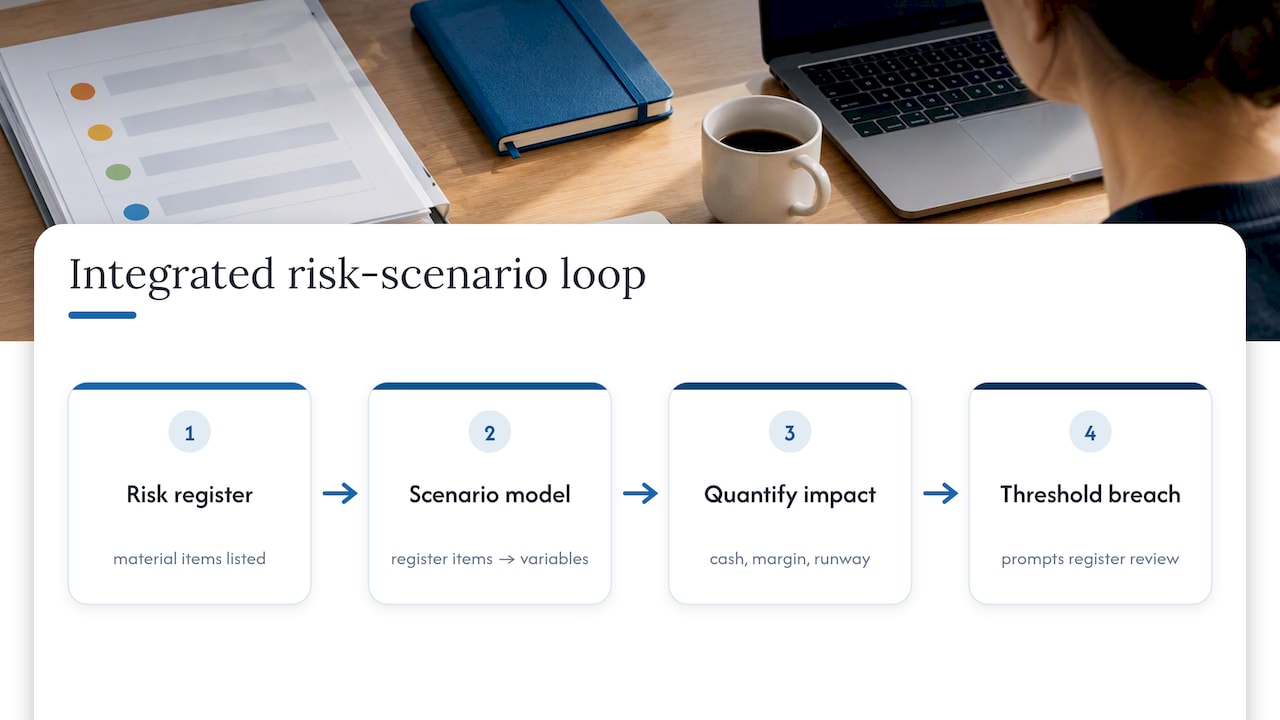
Scenario planning works best when it sits inside, rather than alongside, an existing risk management process. A risk register identifies what could go wrong; scenario planning quantifies what happens to cash, margin and runway if it does, and the two should feed each other continuously rather than operating as separate exercises run by different teams.
In practice, this means every material item on a risk register, a key customer concentration, a currency exposure, a dependency on a single supplier, becomes a variable in the scenario model rather than a line in a document nobody revisits. The OECD’s work on supply-chain resilience makes a similar point in a different context: testing the financial impact of a disruption is only useful when the risk and the model are linked, not maintained in isolation.
Macro-level risks deserve the same treatment. The World Economic Forum’s Global Risks Report 2026 catalogues large-scale systemic shocks that sit outside any single company’s control, and a long-horizon scenario set should reflect at least the ones most relevant to the business’s sector and geography, rather than only the risks finance can see from inside the business.
The practical output of this integration is a model where a change in the risk register prompts a new scenario variable, and a scenario result that breaches a threshold prompts a review of the risk register. Treated this way, scenario planning becomes the quantitative arm of risk management rather than a parallel, disconnected exercise.
Software tools and technologies commonly used for scenario planning in finance
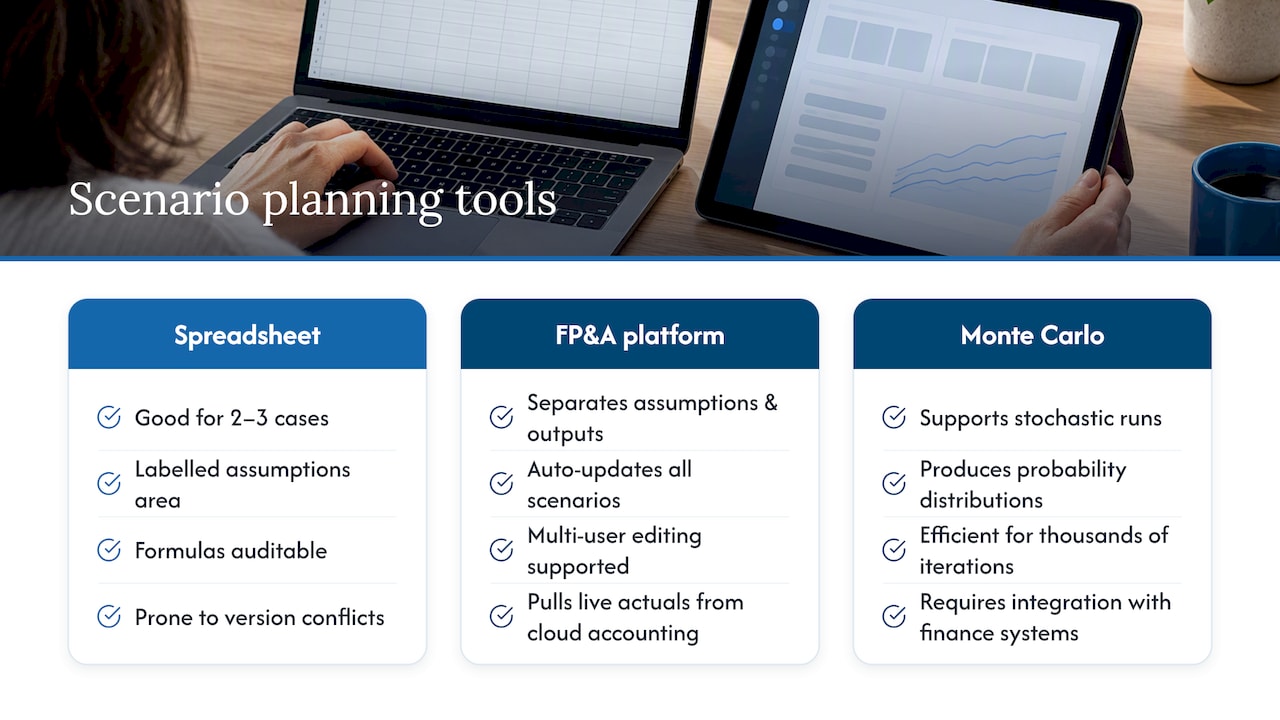
Most finance teams still build their first scenario models in a spreadsheet, and for a business running two or three deterministic cases, that remains a reasonable starting point provided the assumptions area is clearly labelled and the formulas are auditable. Spreadsheets struggle, though, once a team wants to run a stochastic model with thousands of iterations, or wants several people editing the same scenario set without version conflicts.
Dedicated financial planning and analysis platforms address that gap by separating the assumptions layer from the output layer, letting a finance lead flex a driver once and see every scenario update automatically. Cloud accounting systems play a supporting role here too: when the underlying bookkeeping data is live and reconciled, scenario models pull accurate actuals rather than stale exports, which is one reason we build scenario work on top of cloud accounting platforms such as Xero rather than static spreadsheets alone.
For larger or more complex businesses, Monte Carlo simulation add-ins and dedicated FP&A software support the stochastic and stress work described earlier, producing probability distributions that a spreadsheet alone cannot generate efficiently. McKinsey’s research into crisis cash planning notes that connecting internal finance systems with digital modelling tools lets boards run what-if analyses quickly rather than waiting days for a manual rebuild. Whichever tool a team chooses, the discipline matters more than the software: a clean assumptions log in a spreadsheet will outperform a sophisticated platform fed with undocumented inputs.
A finance leader’s take on scenario planning
Scenario planning earns its keep as a governance tool, not a modelling exercise. The real value is not the spreadsheet; it is the agreement, made calmly before a crisis, about what the business will do when a trigger is hit. Most of the founders we talk to only wish they had built that agreement sooner.
— Rahamut
How Price & Accountants can help implement scenario planning
We help finance leaders turn scenario planning from a one-off spreadsheet exercise into a working part of how the business makes decisions. As an outsourced finance partner, we build the assumptions log, run the deterministic and stress cases, and structure the board pack so trustees and investors see a model they can trust rather than a guess dressed up as a forecast.

A typical engagement starts with a conversation about where cash and growth decisions are currently made on instinct rather than on a model, then moves into building or auditing the scenario framework itself through our finance directorship services. From there, we fold the work into ongoing support through our pricing plans, which start at the Core Services tier and scale up to the Black Plan for businesses that need a fuller strategic finance function. Get in touch to find out where your current model stands.
This article is general information, not a substitute for advice from a qualified financial advisor. Consult a qualified financial professional about your own circumstances before acting on anything here.
FAQ
What are the 5 steps of the scenario planning process?
The common process runs: define the decision question and stakeholders, identify key drivers and scenario axes, build a traceable base model, run deterministic or stochastic scenarios with sensitivity checks, then convert outcomes into decision triggers and a monitoring plan. Each step produces a specific output that feeds the next.
What are the four types of financial planning?
Financial planning is generally split into strategic planning, operational or budgeting planning, cash flow forecasting, and risk or contingency planning, with scenario planning sitting across the strategic and risk categories. Definitions vary between organisations, so the groupings are best treated as a practical framework rather than a fixed standard.
What is a scenario planning model?
A scenario planning model is a financial model built to test several plausible future states, rather than a single forecast, by varying key drivers such as revenue growth, hiring pace or currency exposure. It typically pairs a base model with deterministic, stochastic or stress variants and a clearly labelled assumptions log, as recommended in GOV.UK’s financial model guidance.
Can you provide an example of scenario planning?
A software business facing a fundraising delay might model a base case, a downside case where the round slips six months, and a stress case where a major customer churns at the same time. Each scenario would show the resulting cash runway and trigger a specific action, such as a hiring freeze or pursuing bridge finance, as described in McKinsey’s research on crisis cash planning.
Sources
- Gov
- Scenario-based cash planning in a crisis: Lessons for the next normal - McKinsey
- Sensitivity Analysis - Corporate Finance Institute