

Set your treasury policy around three things: prioritise security, liquidity and yield in that order, run a rolling cash forecast updated weekly, and enforce simple segregation of duties on every payment. Together these three controls cover most of the risk a growing company faces, and the rest of this guide shows you exactly how to write, approve and run them.
TL;DR:
- Build and update a 13-week cash forecast weekly, modeling scenarios for base, downside, and worst cases to inform decision-making.
- Implement segregation of duties by splitting payment initiation and approval, and set clear approval limits for roles to reduce fraud risk.
- Diversify deposits across multiple banking groups using notice accounts and deposit platforms to mitigate FSCS protection limits.
- Ensure treasury objectives are integrated with the overall business plan, adjusting thresholds and triggers as the company scales or pivots.
- Maintain a short, board-approved treasury policy, review it biannually, and attach key risk indicators for continuous monitoring.
Table of Contents
- Core components of a startup treasury policy
- Liquidity forecasting and runway management
- Risk, controls and segregation of duties
- Cash protection and deposit strategy for startups
- Implementation checklist and governance steps
- Monitoring, KPIs and reporting formats
- How a specialist adviser supports implementation
- Integration of treasury policy with overall financial strategy and business plan
- Use of technology and treasury management systems for startups
- Compliance and regulatory considerations relevant to startup treasury operations
- Investment policy guidelines tailored for startup cash reserves
- Handling of funding inflows and outflows including equity and debt management
- Rahamut’s short view: common mistakes and quick priorities
- Price & Accountants: implementation support and next steps
- FAQ
- Sources
Core components of a startup treasury policy
A treasury policy only works when it answers four questions: what are we protecting, who decides, what are we allowed to do with cash, and who checks the work. Start with objectives and scope: name the entities, currencies and bank accounts covered, and state plainly that capital preservation comes before returns.
The Association of Corporate Treasurers frames treasury as the active management of liquidity and risk, not a passive holding function, and that framing should sit at the top of your document. The SLY principle, security first, then liquidity, then yield, gives you a simple test for every decision: never chase a better rate if it compromises access to cash or the safety of the deposit.
From there, the policy needs practical mechanics:
- Roles and delegated authorities: name who can initiate a payment, who approves it and who reconciles it, with monetary limits attached to each role.
- Permitted instruments: list approved account types and counterparties (for most early-stage companies this means instant-access and notice accounts with regulated UK banks).
- Counterparty criteria: set a minimum standard, such as a UK banking licence and deposit protection scheme membership, before any new bank relationship is opened.
- Standard settlement instructions (SSIs): fix bank details for recurring payees so a changed instruction triggers a manual check.
- Segregation of duties: separate the person who sets up a payment from the person who authorises it.
A short introduction to treasury management covers the legal responsibilities directors carry for these decisions, which is worth reading alongside your first draft.
Liquidity forecasting and runway management
Liquidity forecasting is the operational heart of any treasury policy, and for an early-stage company it should take one concrete form.
- Build a 13-week rolling forecast and refresh it weekly. Practical treasury guidance recommends this cadence as standard practice for tracking liquidity and runway in real time.
- Model three scenarios with minimal inputs. A base case uses your current burn and confirmed receipts, a downside case delays a fundraise or a large customer payment by a month, and a worst case assumes both happen together.
- Set numeric triggers in advance. Agree the cash balance that triggers a hiring freeze, the runway length that triggers active fundraising, and the balance that triggers an emergency board update.
- Feed the forecast straight into governance. Use the same three-line output (cash, burn, runway) in board packs and investor updates so decisions are made against one source of truth.
A scenario planning guide walks through building these models with templates, which is a faster starting point than building from scratch.
Risk, controls and segregation of duties
Fraud and error risk in a small team rarely comes from sophistication, it comes from one person holding too much control over payments. Segregation of duties and clear SSIs are described as materially reducing that exposure, and they cost nothing to implement beyond discipline.
Practical steps for a lean finance function:
- Split initiation and approval. The person who raises a payment in your accounting system should never also be the sole approver in online banking.
- Fix supplier bank details in advance. Treat any change to a supplier’s bank details as a red flag requiring a phone call back to a known contact, not an email reply.
- Set payment limits by role. A junior finance hire might initiate payments up to a set amount, with anything above it requiring founder or finance director sign-off.
- Review exception reports weekly. Bank feeds in your accounting software should flag unusual payments automatically, not rely on someone remembering to check.
- Run an independent check periodically. A finance director or external adviser should review the bank mandate and payment list on a schedule, not only when something looks wrong.
Pro Tip: Keep your bank mandate list shorter than your org chart, people leave faster than anyone updates the bank.
Cash protection and deposit strategy for startups
Once a company holds more cash than a single bank’s protection covers, deposit concentration becomes a real risk rather than a theoretical one. The Financial Services Compensation Scheme protects eligible deposits up to £85,000 per banking group, which means a seed or Series A round sitting in one account is largely unprotected beyond that threshold.
Spreading deposits is the practical response:
- Open accounts with more than one banking group, since protection applies per group, not per account.
- Use notice accounts for cash you will not need for 30 to 95 days, trading a little liquidity for a better rate without leaving the SLY order of priority.
- Consider specialist cash deposit platforms that place funds across multiple institutions automatically, but check the fees, notice periods and underlying bank list before signing up.
- Review the arrangement each quarter as your balance changes, since the right structure at £200,000 in the bank looks different from the right structure at £2 million.
Founders setting up outside the UK face a related decision: a guide to opening a UAE corporate bank account is a useful reference if part of your group is incorporated there, though the FSCS protection discussed above applies only to UK-regulated deposits.
Implementation checklist and governance steps
Writing the policy is the easy part, embedding it is what founders skip. HSBC’s guidance for startups sets out a four-step approach that maps neatly onto a founder’s actual week.
- Set objectives and assess risks by listing every bank account, currency and major counterparty you deal with.
- Map exposures and assign ownership so each risk (concentration, fraud, FX, interest rate) has a named owner.
- Define limits for payment authorisation, deposit concentration and permitted instruments.
- Write the procedures in plain language, short enough that a new hire can follow them without training.
- Approve the policy formally at board level, with the date and version recorded.
- Communicate it to everyone who touches payments, not just the finance team.
Review the policy at least twice a year, and treat a fundraise, a sudden jump in cash balance or a banking problem as an automatic trigger for an out-of-cycle review. Keep a simple document log: policy version, approval date, next review date.
Pro Tip: Attach your treasury policy to your data room before a fundraise, investors ask for it more often than founders expect, as the due diligence guide sets out.
Monitoring, KPIs and reporting formats
A policy that nobody checks against real numbers is just a document. HSBC and other treasury resources recommend attaching key risk indicators to the policy so you know when it is working and when it is not.
Track a short list consistently:
- Available liquidity against your defined minimum reserve, checked weekly.
- Runway in months, recalculated every time the forecast updates.
- Deposit concentration per banking group, checked monthly against your FSCS threshold.
- Breach count, meaning any time a payment exceeded a limit without the correct approval.
Two formats cover most needs: a one-page executive summary for the board, and a running transaction log for the finance team. Agree in advance who gets told immediately if a breach happens and who only sees it in the monthly pack.
How a specialist adviser supports implementation
Drafting the policy, building the first forecast model and setting up bank mandates correctly takes time most founders do not have in the early months. Outsourced finance director support, of the kind we provide through our treasury management overview, is built around exactly this work: policy drafting, forecast set-up and bank relationship structuring, typically delivered over the first few weeks of an engagement rather than as a one-off document.
Integration of treasury policy with overall financial strategy and business plan
A treasury policy that sits apart from your business plan tends to get ignored the first time the two disagree. The better approach treats treasury as one output of the same planning process that produces your budget and your fundraising timeline, not a separate compliance exercise bolted on afterwards.
In practice, this means your hiring plan, your fundraising calendar and your cash policy should be built from the same assumptions. If the business plan assumes a Series A closes in month nine, the treasury policy’s reserve thresholds and hiring-freeze triggers should be set against that same month nine, not against a generic rule of thumb borrowed from a template.
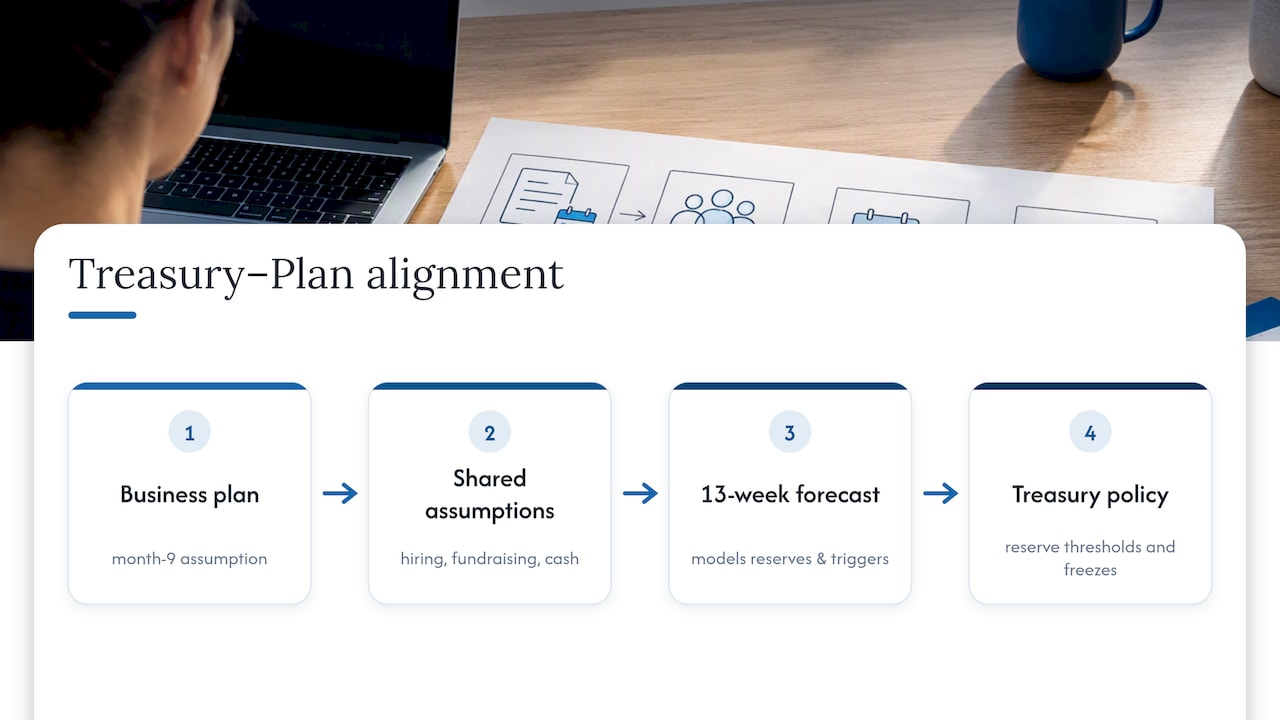
It also means revisiting the treasury policy every time the business plan changes materially, a new product line, a pricing change, a geographic expansion, each shifts your cash profile and risk exposure. A company moving into a second country, for example, introduces new currency exposure and potentially a new banking relationship, both of which belong in the policy, not as an afterthought once the bank account is already open.
Finance directors, whether in-house or outsourced, usually act as the bridge between these two documents, translating commercial decisions into treasury limits and flagging when a commercial plan assumes a level of cash buffer the treasury policy does not actually protect. That conversation works best when it happens at the planning stage, not when cash is already tight.
Use of technology and treasury management systems for startups
Most early-stage companies do not need a dedicated treasury management system, the spreadsheet-plus-cloud-accounting combination most founders already use is usually sufficient for the first few years. What matters more than the software is whether bank feeds flow into it automatically and whether the forecast updates without manual re-entry each week.
Cloud accounting platforms such as Xero, paired with direct bank feeds, do most of the heavy lifting: they surface exception reports, keep a running reconciliation and make the weekly forecast update a matter of minutes rather than hours. Accurate bookkeeping set up correctly at the start makes every later treasury control easier to maintain, since forecasting and reconciliation both depend on clean, current data.
As balances grow and banking relationships multiply, some companies move to dedicated cash management platforms that consolidate multiple bank accounts into one view and, in some cases, automate deposit placement across institutions for FSCS diversification purposes. The decision to adopt one of these platforms should follow the same SLY test as everything else in the policy: check what happens to your cash’s safety and accessibility before evaluating the yield or efficiency gain.
Compliance and regulatory considerations relevant to startup treasury operations
Treasury decisions sit inside existing company law and tax obligations, they are not a separate regulatory regime for most startups. Directors carry a duty to act in the company’s interests, which includes safeguarding cash reasonably, a responsibility that underpins why a formal, board-approved treasury policy matters even for a small team.
VAT and payroll obligations interact directly with treasury: a company that has not forecast its VAT or PAYE liabilities properly can find a healthy-looking bank balance is mostly already owed to HMRC. Building known tax payment dates into the 13-week forecast avoids this becoming a surprise.
Where a startup holds SEIS or EIS-qualifying investment, the treasury policy should also respect the conditions attached to that funding, since certain uses of cash or corporate changes can affect investor tax relief. This is a case where treasury policy and tax compliance genuinely overlap, and it is worth getting advice before assuming a cash management decision is purely operational.
None of this requires a compliance department, it requires the policy to name who checks tax deadlines against the cash forecast and how often.
Investment policy guidelines tailored for startup cash reserves
Most startup cash should not be invested in anything beyond standard bank deposits, and that is a deliberate, defensible position rather than a missed opportunity. The SLY ordering, security before liquidity before yield, means a company whose runway depends on its cash balance should treat capital preservation as the only real objective until reserves comfortably exceed operating need.
For the portion of cash genuinely surplus to the next 12 to 18 months of runway, a narrow set of options fits the risk profile: notice accounts with a fixed return date, short-term fixed deposits that mature before the cash is likely to be needed, and spreading balances across more than one banking group to manage FSCS exposure. Each of these preserves both security and liquidity while accepting a modest yield improvement over an instant-access account.
What should sit outside any startup investment policy is anything with capital risk, equities, corporate bonds, structured products or similar instruments have no place in a treasury policy whose primary job is protecting the company’s ability to pay salaries and suppliers. A board that wants exposure to investment returns should seek that outside the operating company’s cash reserves, not inside a policy meant to guarantee runway.
Handling of funding inflows and outflows including equity and debt management
A funding round changes a company’s treasury risk overnight, moving it from managing tens of thousands of pounds to managing a balance that may sit well above FSCS protection limits at a single bank. The policy should anticipate this before the round closes, not after the funds land, with a pre-agreed plan for which accounts receive the money and how quickly it gets spread across banking groups.
Debt introduces a different set of obligations: covenant checks, interest payment dates and repayment schedules all need to sit inside the same forecast that tracks operating cash, since a missed covenant test is as damaging as running out of operating runway. Any venture debt or convertible loan note terms should be logged against the 13-week forecast so repayment or conversion dates never arrive as a surprise.
On the equity side, treasury policy intersects with SEIS and EIS compliance: certain company actions after a qualifying round, such as large asset purchases or changes to trading activity, can affect investor relief, so funding inflows should be flagged to whoever manages that compliance before cash is deployed into anything unusual. Outflows tied to the round, supplier payments, new hires, capital expenditure, should be tracked against the same budget the fundraise was based on, so the business plan and the treasury forecast stay aligned rather than drifting apart within the first few months of new cash arriving.

Rahamut’s short view: common mistakes and quick priorities
The mistakes I see repeat: all cash in one bank, no weekly forecast, and a single person able to both set up and approve a payment. Fix the second and third this week, they cost nothing and close most of the gap before your next board meeting.
— Rahamut
Price & Accountants: implementation support and next steps
Getting a treasury policy drafted, approved and actually followed usually takes longer than founders expect when it competes with product and sales priorities. We support this directly through our services, including outsourced finance director work, bookkeeping set-up and R&D tax credit claims that often run alongside treasury planning for growing tech companies.

Our Core Services, Blue Plan and Black Plan are built for founders who want this handled properly from the first draft through to board approval and ongoing monitoring. Contact us to learn more about which plan may fit your stage.
FAQ
What are the top treasury management systems for startups?
Most early-stage companies manage well with cloud accounting software such as Xero paired with direct bank feeds, moving to a dedicated cash platform only once balances and banking relationships grow. There is no single standard list for startups specifically, the right choice depends on balance size and the number of banking relationships involved.
What are the four pillars of treasury management?
The four pillars are liquidity management, risk management, funding and capital management, and operational controls, with the SLY principle of security, liquidity and yield guiding priority within them. Startups should apply all four at a simple scale rather than skipping any.
What is a treasury management strategy?
A treasury management strategy is the set of objectives, controls and processes a company uses to protect cash, manage liquidity and limit financial risk. For a startup, that typically means a written policy covering bank mandates, a rolling cash forecast and clear approval limits.
What is the role of treasury in a company?
Treasury’s core role is managing liquidity and financial risk so the business can meet its obligations and fund its plans, a function the Association of Corporate Treasurers describes as active stewardship rather than passive cash-holding. In a startup this usually falls to the founder or an outsourced finance director rather than a dedicated team.
How do I start implementing a treasury policy quickly?
Begin with a short document covering objectives, a 13-week rolling forecast and segregation of duties on payments, then get it approved at board level before adding further detail. Review it twice a year and immediately after any fundraise or major banking change.
Sources
- Four pillars of leading-practice treasury management | The Global Treasurer
- What is treasury? | Association of Corporate Treasurers
- Practical liquidity management for treasurers | ACT Learning
- How to set up a treasury policy for a startup | HSBC Innovation Banking
- Insignis Cash Solutions example note (FSCS illustration)