

Meta title: UK Bank Account for Non-Resident Founders: How to Open One
Meta description: Learn how US and overseas founders can open a UK business bank account before landing, including realistic providers, documents, timelines and compliance checks.
Incorporating a UK company can take a day. Opening the account that allows you to trade is where plans often stall.
Without a working UK account, your first hiring date can slip, invoices may be paid late, VAT and payroll become harder to manage, and investor funds can sit in limbo whilst your runway continues to burn.
If you are searching for a uk bank account for non resident founders, the good news is that routes exist. But the realistic route depends on your directors, shareholders, trading activity, proof of address and how clearly you explain the relationship between your UK company and any US parent.
This guide explains how to plan your application before you land.
Why do UK banks reject or delay non-resident directors?
A bank is not only asking whether your company exists. It is asking whether it understands the business, the people behind it and the expected flow of money.
For a non resident director bank account, providers commonly assess:
- UK-established presence: Why does the company need a UK account, and what UK activity is expected?
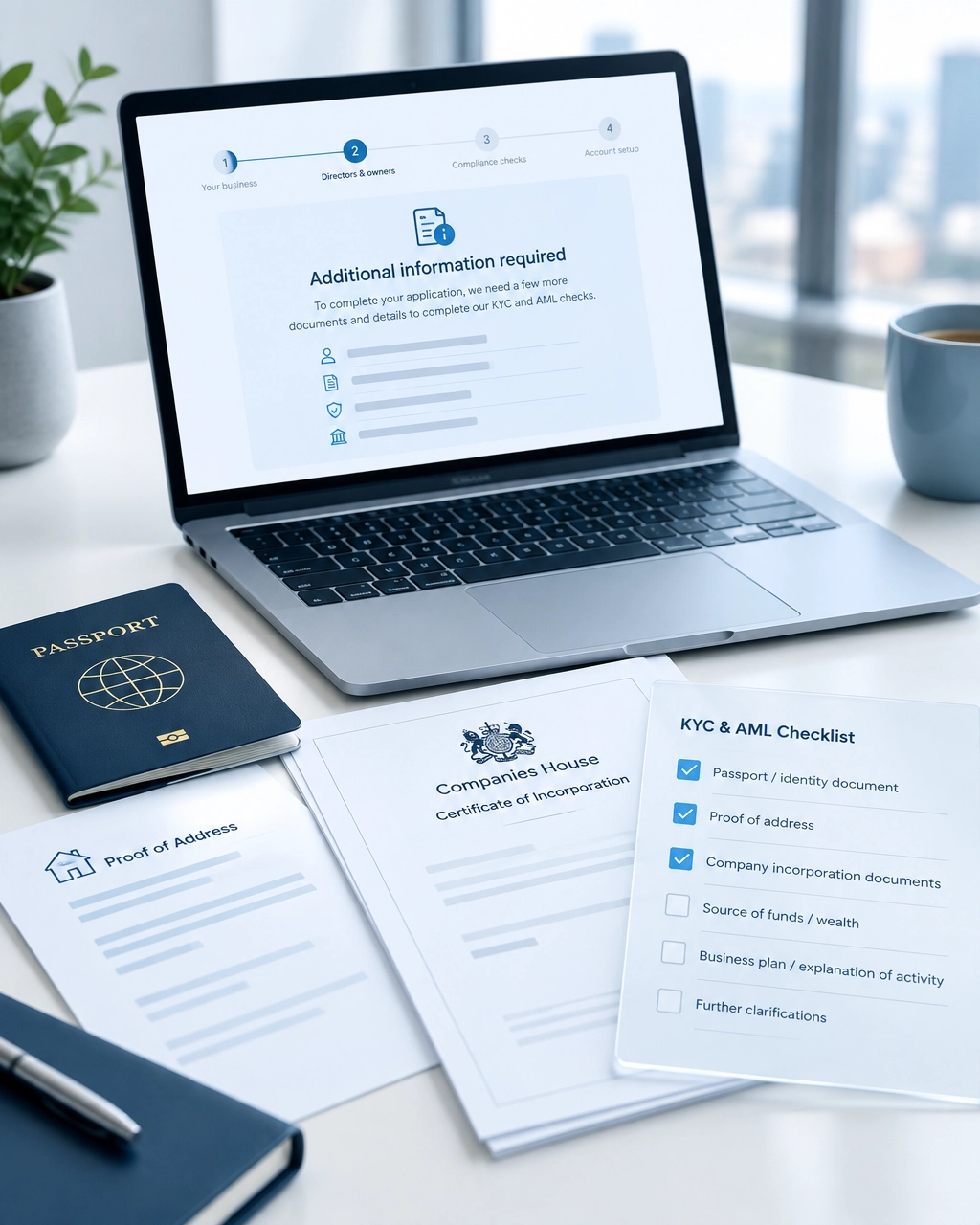
- KYC and AML checks: Know Your Customer and anti-money laundering checks verify directors, shareholders and ultimate beneficial owners.
- Proof of address: Your residential address may be overseas, but the provider still needs reliable, recent evidence.
- Source of funds: The bank may ask where initial capital, investment or shareholder loans originate.
- Expected transaction profile: You may need to explain expected monthly revenue, payment destinations, currencies, suppliers and payroll.
- Ownership structure: A US parent, multiple shareholders or a layered uk company structure for foreign owners can trigger further questions.
Traditional high-street banks can be particularly slow with overseas directors. The UK Government notes that a full account may take four weeks to three months, especially where meetings, enhanced checks or overseas verification are required.
And a virtual registered office is not the same as genuine business activity. It can satisfy incorporation requirements, but it does not automatically persuade a bank that your company is ready to trade.
Which UK account route is realistic for an overseas founder?
There is no universal “best” business bank account UK non resident option. The right choice depends on whether you need local GBP payments, multi-currency capability, FSCS protection, lending, payroll functionality or simply a practical account to start trading.
| Account route | Realistic timeline | What it usually asks for | Best suited to |
|---|---|---|---|
| High-street bank | 4 weeks–3 months | UK business details, director and shareholder ID, proof of address, business plan, source of funds and often an in-person meeting | Businesses with a strong UK presence, UK-resident representation or longer-term lending needs |
| Challenger or fintech business account | A few days–2 weeks | Companies House details, identity checks, ownership information, business activity and address evidence | Early-stage companies seeking quicker digital onboarding |
| Electronic money institution (EMI) | 24 hours–10 business days | Company registration, director ID, residential address, ownership chart and expected payment activity | International companies needing GBP, multi-currency payments and remote access |
| Overseas-parent or international bank option | 2–8 weeks | Evidence of the US parent, group structure, intercompany activity, source of funds and UK purpose | A US company expanding to UK with an established banking relationship |
For many founders trying to open a UK company from USA or elsewhere, a fintech or EMI is the most realistic first route.
Providers such as Wise Business, Revolut Business, Airwallex and Tide may accept UK companies with overseas directors, subject to their own eligibility rules.
Check the distinction carefully. An EMI may provide account details, payment services and cards, but it is not necessarily a bank. Funds may be safeguarded in segregated accounts rather than covered by the Financial Services Compensation Scheme. That can be entirely suitable for day-to-day trading, but it matters when deciding where to hold substantial reserves.
Master timeline: work backwards from landing in the UK
The key is to begin preparation before you apply. Do not submit incomplete applications to several providers and collect avoidable rejections on your record.
Six to eight weeks before landing
Decide whether a UK private company limited by shares is appropriate, or whether a UK subsidiary, branch or another structure better reflects your US operations. Then prepare the ownership chart showing every shareholder and ultimate beneficial owner.
If you need help to set up a UK company from USA, our company formation and UK set-up support can help you establish the practical foundations before banking becomes urgent.
Four to six weeks before landing
Incorporate the company and obtain:
- Certificate of Incorporation;
- Articles of Association;
- Companies House company number;
- UK registered office details;
- Director and PSC information;
- Confirmation of the company’s business activities.
Apply for the company’s UTR and register for Corporation Tax when required. If employees will be hired, plan the PAYE scheme and pension duties in advance rather than waiting for the first payday.
Companies House identity verification requirements also form part of the modern onboarding environment. Ensure directors and people with significant control can complete the required checks, particularly where they live overseas.
Two to four weeks before landing
Prepare a concise banking pack:
- A one-page business summary explaining what the company sells.
- A 12-month revenue and cash-flow forecast.
- Expected monthly payment volumes and currencies.
- Details of UK customers, suppliers, contractors and staff.
- The reason the company needs a UK account.
- Details of any US parent, shareholder loan or investment funding.
- A clear ownership and group structure chart.
Also gather passports, recent proof of residential address, US company documents, bank statements and evidence of source of funds. Overseas documents may need certified translations or legalisation if requested.

Before submitting the application
Select the provider based on your actual needs. Consider:
- GBP account details and Faster Payments;
- USD and other currency support;
- payroll and supplier payment capability;
- Xero integration;
- transaction limits;
- card and user permissions;
- safeguarding or FSCS protection;
- access to lending or overdraft facilities;
- whether your directors’ countries of residence are supported.
Then submit one complete, consistent application. Your company description, website, forecast and answers to KYC questions should tell the same story.
Non-resident banking compliance checklist
Before applying, confirm that you have:
- Certificate of Incorporation and company number.
- UK registered office and business contact details.
- Passport or accepted photo ID for every director and relevant owner.
- Recent proof of residential address for each director and PSC.
- Ownership chart showing shareholders and ultimate beneficial owners.
- US parent company documents, if applicable.
- Business plan and 12-month forecast.
- Evidence explaining source of funds.
- Contracts, invoices, website or other evidence of expected activity.
- Details of expected countries, currencies and transaction volumes.
- PAYE plans if you will employ UK staff.
- A clear explanation of why the UK company needs a UK account.
Applications are commonly delayed by inconsistent company descriptions, unexplained shareholder loans, missing address evidence, unclear ownership, unrealistic forecasts and unexplained transfers between the US and UK.
How do structure and cross-border tax affect banking?
A straightforward UK limited company with clearly documented ownership is often easier to explain than a complex group structure. However, the simplest structure is not automatically the most tax-efficient.
If a US parent owns the UK company, the bank may ask about:
- Intercompany services;
- Shareholder loans;
- Transfer pricing;
- Which entity signs customer contracts;
- Where staff and directors work;
- Where intellectual property is owned;
- Whether money will move regularly between the entities.
This is where cross border tax US UK planning becomes important. UK Corporation Tax, US reporting, permanent establishment, withholding tax, transfer pricing, VAT and payroll can interact in unexpected ways.
Our advisory and tax planning service can help you map the banking structure against your wider compliance obligations. The goal is not just to obtain account details; it is to create a finance function that remains defensible as your business grows.
Common mistakes to avoid
Applying to a high-street bank first without checking eligibility. A rejection can create delay and does not solve your immediate trading problem.
Using a registered office as proof of personal residence. Your company address and your director’s residential address serve different purposes.
Underestimating the US parent relationship. If funds will come from a US entity, document whether they are investment, a loan, revenue or an intercompany recharge.
Choosing an account only because it opens quickly. Check payment limits, safeguarding, integrations and whether it can support payroll, VAT and investor activity.
Treating your US bank account as a permanent substitute. You can often receive and send international transfers through it, but a UK account can reduce friction, simplify reconciliation and make local payments easier.
What does a working UK account unlock?
Once the account is operational, your UK company can move from incorporation to controlled trading.
You can pay staff on time, automate supplier payments, receive investor funds, collect GBP customer payments and keep a clean transaction trail feeding into cloud bookkeeping and accounting.
With the right setup, payroll and pension services can run on schedule, whilst VAT compliance is supported by complete and timely records.
That clarity becomes increasingly valuable before a funding round or Series A. Investors want to see that money moves through the correct entity, records reconcile and compliance is not dependent on emergency fixes.

FAQs: UK bank account for non-resident founders
Can a non-resident open a UK business bank account?
Yes. Non-residents can open a UK business account, but acceptance depends on the provider, directors’ countries of residence, ownership, business activity and verification checks. Fintech and EMI providers are often more accessible than traditional banks.
How long does it take?
A digital account may be approved within days if your documents are complete. A traditional bank can take four weeks to three months, particularly where an in-person meeting or enhanced due diligence is required.
Do I need a UK residential address?
Not always. Many providers accept overseas residential addresses, provided you can provide valid proof. A UK registered office is generally needed for the company, but it does not replace personal address evidence.
Can I use my US bank account instead?
You can use your US account for international transfers, but this may create FX costs, slower payments and more difficult UK payroll or supplier processes. A UK account is usually more practical once the company begins local trading.
Can I use Wise, Revolut Business, Airwallex or Tide?
Potentially. Each provider has its own eligibility rules, account functionality and regulatory model. Check supported countries, payment limits, fees, safeguarding and whether the account meets your payroll, VAT and investor requirements.
Can I register a UK company as a non-resident?
Yes. You can register a UK company as non resident, subject to Companies House requirements and maintaining an appropriate UK registered office. Banking is a separate approval process and is not guaranteed by incorporation.
Prepare before you land
The most effective approach is to treat banking as part of your UK launch plan, not as an administrative task after incorporation.
We encourage you to arrange a UK Banking & Set-Up Readiness Check before applying. We can review your proposed structure, director profile, documents, forecast, US–UK money flows, payroll timing and VAT position, then help you identify the most realistic route.
That preparation can be the difference between landing ready to trade and arriving with a company that exists on paper but cannot yet move money.