

Most UK small and medium-sized enterprises remain exempt from formal transfer pricing documentation, and that stays true after the Finance Act 2026 reforms. The exemption does not remove the duty to price related-party deals at arm’s length, so the one action that matters is keeping reasonable, contemporaneous records of pricing decisions now, before HMRC asks or before you cross into cross-border related-party territory.
TL;DR:
- UK SMEs generally remain exempt from preparing comprehensive transfer pricing documentation like master and local files, but must still keep reasonable records to justify arm’s length pricing.
- The SME thresholds depend on staff numbers and turnover or balance sheet total, aggregated across the entire group, with group and control linkages influencing SME status.
- From January 2026, UK-to-UK transactions are largely out of scope for transfer pricing, but cross-border deals and transactions with non-treaty jurisdictions still require compliance.
- The broadened participation test means shared management or directors can now create transfer pricing scope, even without controlling ownership, requiring review of board structures.
- Basic record-keeping should include transaction registers, signed agreements, pricing rationale, comparability evidence, and contemporaneous records, which can suffice for SME compliance purposes.
Table of Contents
- SME definition for transfer pricing: staff, turnover and group treatment
- Which transactions are in scope after the 2026 reforms and key exceptions
- What the Transfer Pricing Records Regulations 2023 require
- Practical record-keeping checklist and low-cost steps for SMEs
- When HMRC can require transfer pricing documentation
- Practitioner perspective from Price & Accountants
- How Price & Accountants can help with transfer pricing documentation
- FAQ
- Sources
SME definition for transfer pricing: staff, turnover and group treatment
HMRC applies EU-derived thresholds to decide who qualifies as a small or medium enterprise for transfer pricing purposes. A small enterprise has no more than 50 staff and either turnover or a balance sheet total below €10 million; a medium enterprise has no more than 250 staff and turnover below €50 million or a balance sheet total below €43 million, according to HMRC’s SME exemption guidance. These limits apply across the whole group, not just the filing entity.
- Group aggregation: figures from associated or linked enterprises are combined when testing the thresholds.
- Linked enterprises: a company that controls, or is controlled by, another counts towards the group’s totals.
- Investor stakes matter: significant shareholdings by venture investors can pull a company into “linked enterprise” territory depending on the holding.
Take a seed-stage tech company with 12 staff, a sister entity in Ireland with 8 staff, and a venture investor holding a minority stake. If the investor’s holding does not constitute control under the linking rules, the group test applies only to the two trading entities, likely keeping the business well inside the small category. Founders should recheck this test at each funding round, since new investor rights or board control provisions can change the answer.
Which transactions are in scope after the 2026 reforms and key exceptions
From accounting periods beginning on or after 1 January 2026, the general requirement to apply transfer pricing to UK-to-UK transactions is repealed, according to HMRC’s guidance on the Finance Act 2026 changes. That removes a layer of compliance for SMEs trading purely between UK group companies, but it is not a blanket exemption from transfer pricing scrutiny.
- UK-to-UK transactions: generally out of scope from 1 January 2026, except where there is identified tax risk.
- Cross-border related-party transactions: remain fully in scope regardless of company size.
- Dealings with non-treaty territories: transactions with jurisdictions lacking treaty non-discrimination protections stay within scope.
- Transactions affecting the UK tax base: HMRC retains the ability to apply transfer pricing where UK tax revenue is at risk.
The participation test, which decides whether two parties count as “related” for transfer pricing purposes, has also broadened. As of 2026, it now captures arrangements involving common management, not only shared ownership, according to Tolley’s overview of UK transfer pricing rules. That matters for SMEs where the same director sits on the board of two related companies: shared management alone can now create transfer pricing scope even without a controlling shareholding, so founders running parallel entities should review their board structures.
What the Transfer Pricing Records Regulations 2023 require
The Transfer Pricing Records Regulations 2023 introduced a three-tier documentation model: a Master File covering the group’s global business, a Local File detailing the UK entity’s specific transactions, and a Summary Audit Trail (SAT) recording the process used to arrive at the Local File’s conclusions.
- Master File: a group-level overview of the business, its value drivers and its transfer pricing policies.
- Local File: entity-specific detail on controlled transactions, functions and comparability analysis.
- Summary Audit Trail: a short record of the steps taken to test and confirm arm’s length outcomes.
These Regulations are built for large multinationals. They apply principally to groups meeting the Country-by-Country Reporting threshold of €750 million or more in global consolidated revenue, as confirmed by the Transfer Pricing Records Regulations 2023. An SME well below that scale is not required to prepare a Master File, Local File or SAT.
That does not mean no records are needed. HMRC’s own guidance makes clear that exemption from the specified documents does not remove the underlying arm’s length obligation, and HMRC can still issue a transfer pricing notice requiring a business to recalculate taxable profits where appropriate, according to HMRC’s overview of transfer pricing records. A growing SME should treat the Regulations as a signal of what “good” documentation eventually looks like, worth adopting in simplified form well before the CbCR threshold becomes a realistic concern.
Practical record-keeping checklist and low-cost steps for SMEs
You do not need a full Local File to demonstrate arm’s length pricing. A short, consistently updated set of records usually does the job.
- Keep a transaction register listing every cross-border related-party deal, date and amount.
- Retain signed contracts and intercompany agreements, with version dates clearly marked.
- Write a short pricing rationale for each material transaction, explaining why the price reflects market terms.
- Note basic comparability evidence, such as third-party quotes or published market rates used to benchmark the price.
- Export accounting records from your bookkeeping system to show figures were recorded contemporaneously, not reconstructed later.
- Save emails or meeting notes that show when pricing decisions were made and by whom.
Low-cost tactics make this manageable without a dedicated tax team: a simple spreadsheet template for the register, a quick web-based comparability search for licence or service fees, and using Xero or a similar cloud platform to timestamp reports automatically. Date-stamped PDF versions of licences and agreements add another layer of proof if a transaction is ever questioned.
Pro tip: Convert these informal records into an OECD-style Local File once your group approaches CbCR materiality, starts operating in several jurisdictions, or begins fundraising rounds where investors expect formal documentation.

When HMRC can require transfer pricing documentation
HMRC has statutory powers to issue information notices and transfer pricing notices requiring a business to produce specific records or recalculate profits on an arm’s length basis. Some notices asking for specified transfer pricing records are not appealable, according to HMRC’s guidance on transfer pricing records, which puts the onus squarely on the taxpayer to respond.
Where records are missing or cannot be produced, there is a presumption that any resulting inaccuracy was careless. A taxpayer rebuts that presumption with contemporaneous evidence, which is why the checklist above matters well before any notice arrives.
If you receive a request:
- Gather the specific documents named in the notice rather than everything you hold.
- Log the dates records were created, not just the dates of the transactions themselves.
- Seek specialist advice before responding, particularly where the notice covers several tax years.
- Consider whether a voluntary disclosure is appropriate if the review uncovers a genuine pricing error.
Practitioner perspective from Price & Accountants
Over more than 40 years of advising growing businesses, the pattern repeats: founders treat transfer pricing as a large-company problem until a funding round, an overseas sale, or an IP licensing arrangement brings a related party into the picture. Working daily with tech and fintech start-ups on Xero-based cloud accounting, outsourced finance director support and cross-border set-up, we see the same trigger points: a UK company licensing software to a US sister entity, or two companies sharing a director under the broadened participation test.
Early, proportionate record-keeping costs little and saves a great deal later. A transaction register and a short pricing rationale, built when the deal is made, is far cheaper than reconstructing the same evidence two years into an HMRC enquiry.
— Rahamut
How Price & Accountants can help with transfer pricing documentation
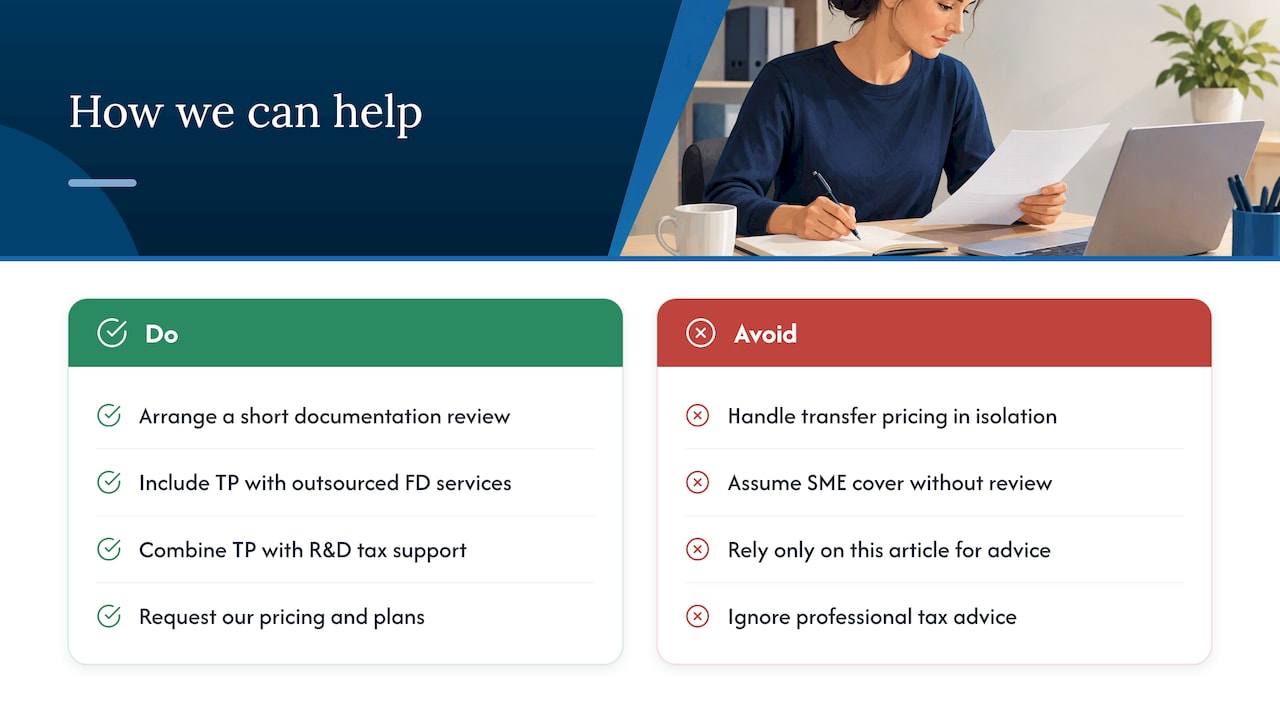
If your business trades across borders, licenses IP to a related entity, or shares directors with a sister company, a short documentation review can confirm whether you are genuinely covered by the SME exemption or need a simple local file in place.

Our advisory and tax planning team works alongside outsourced finance director services and R&D tax credit support, so transfer pricing questions get handled alongside the rest of your compliance rather than in isolation. This is an optional paid engagement: view our pricing and service plans to arrange an initial review.
This article is general information, not a substitute for advice from a qualified financial advisor. Consult a qualified financial professional about your own circumstances before acting on anything here.
FAQ
Are UK SMEs exempt from transfer pricing rules?
Most UK SMEs remain exempt from the formal Master File, Local File and Summary Audit Trail requirements under the Transfer Pricing Records Regulations 2023. They still need to price related-party transactions at arm’s length and keep reasonable records to demonstrate this if HMRC asks.
What counts as an SME for transfer pricing purposes?
HMRC defines a small enterprise as having no more than 50 staff and either turnover or a balance sheet total below €10 million, and a medium enterprise as having no more than 250 staff and turnover below €50 million or a balance sheet total below €43 million, applied on a group basis, according to HMRC’s SME definition guidance.
Do UK-to-UK transactions still need transfer pricing documentation?
For accounting periods beginning on or after 1 January 2026, the general requirement to apply transfer pricing to UK-to-UK transactions is repealed, with exceptions where there is identified tax risk, according to HMRC’s Finance Act 2026 guidance. Cross-border related-party transactions remain in scope regardless of this change.
Can HMRC still ask an SME for transfer pricing records?
Yes. HMRC can issue information notices and transfer pricing notices even where a business is exempt from the specified documentation, and some of these notices cannot be appealed, according to HMRC’s transfer pricing records overview. Missing records can lead to a presumption of careless inaccuracy unless rebutted with contemporaneous evidence.
Will the SME exemption change again soon?
A 2025 government consultation confirmed that small enterprises will continue to benefit from the SME exemption, while introducing an International Controlled Transactions Schedule for larger taxpayers, according to the consultation outcome summary. HMRC has said it will keep the exemption under review, so SMEs approaching medium-sized thresholds should monitor future guidance.
Sources
For your own reference, the primary sources behind this guidance are listed below. Always check your specific circumstances against current primary guidance before relying on any exemption.
- INTM414320 - Transfer pricing: application following reform (Finance Act 2026)
- The Transfer Pricing Records Regulations 2023