

TL;DR:
- Scaling the finance function involves redesigning the operating model to support growth without bottlenecks.
- The key step is mapping decisions finance must enable and identifying the main constraints before adding resources.
Scaling the finance function means redesigning your finance operating model so that the business can grow in complexity and revenue without finance becoming the bottleneck. It is not primarily about hiring more people or buying new software. The first action is straightforward: map every significant decision the business will need finance to enable over the next 12–24 months, then identify the single biggest constraint standing in the way, whether that is a process gap, a data problem, a capability shortfall, or a headcount issue. According to CFO Excellence, complexity rather than revenue should drive finance structure, and a finance function that cannot enable decisions quickly is already a drag on growth.
TL;DR
- Scaling finance is about operating model design first, headcount second.
- Map the decisions finance must enable before deciding what to fix.
- Identify your single biggest constraint: process, data, capability, or people.
- Tools like Xero and QuickBooks Online, combined with proper cloud accounting practices, reduce transactional load quickly.
- Companies House filings, VAT, and payroll obligations do not pause while you scale.
Pro Tip: Before posting a single job advert, spend one week logging where your senior finance time actually goes. If a significant portion of senior time is transactional, the constraint is process or automation, not headcount.
Table of Contents
- Why a scalable finance function matters to everyone in the room
- How do you know it is time to scale finance now?
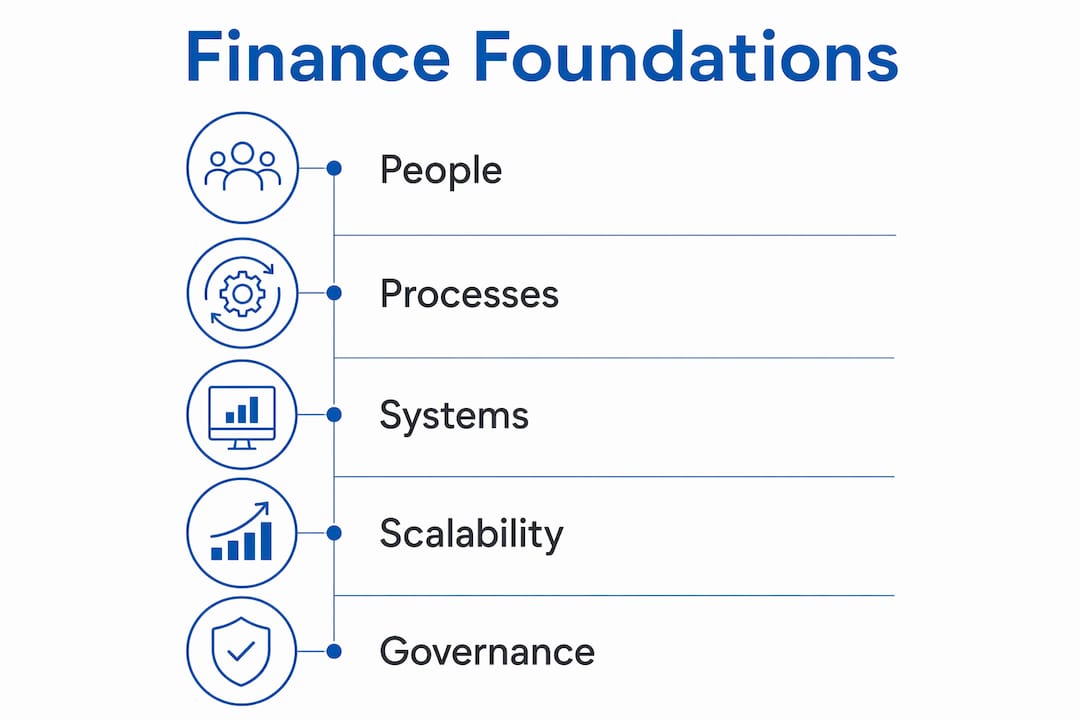
- The three foundations: people, processes, and systems
- Which technology actually speeds up finance scaling?
- Centralised, decentralised, or outsourced: which structure fits your business?
- What KPIs and governance does a scaled finance function need?
- A 6–24 month implementation roadmap with ballpark costs
- How a UK scale-up stabilised and scaled its finance function
- Key takeaways
- The thing most finance leaders get wrong about scaling
- How Priceandaccountants helps growing businesses scale their finance function
- Further reading and useful UK sources
Why a scalable finance function matters to everyone in the room
A finance function that cannot keep pace with growth does not just slow down the finance team. It slows down the whole business. Decisions stall because the numbers are not ready. Cash crises arrive without warning because forecasting is fragile. Investors lose confidence when management accounts arrive late and contain errors.

The upside of getting this right is measurable. Faster month-end closes give commercial teams reliable margin data before they price the next contract. Accurate cash forecasting extends runway visibility from weeks to months. Investor-grade reporting shortens due diligence timelines during funding rounds. These are not abstract benefits; they show up in deal speed, cost of capital, and the quality of decisions the CEO makes on a Monday morning.
Stakeholders who feel the difference most:
- CEO and founders: faster, more reliable data for strategic decisions.
- Board and investors (PE/VC): confidence in the numbers underpinning valuations and covenants.
- Operations and commercial teams: timely margin and unit economics data to price and prioritise.
- HR: accurate payroll and headcount cost visibility for workforce planning.
- External auditors and Companies House: clean records that reduce audit friction and avoid late-filing penalties.
The cost of getting it wrong compounds quickly. A lengthening month-end close, recurring reconciliation errors, and a single person who holds all the knowledge are not just operational irritants. They are early warning signs of a finance function that will crack under the weight of the next growth phase.
Pro Tip: Match finance shape to complexity, not revenue. A £5m business with five legal entities, multi-currency transactions, and investor reporting needs more finance infrastructure than a £20m business with a single UK entity and straightforward revenue streams.
How do you know it is time to scale finance now?
Most leaders wait too long. By the time the pain is obvious, the business has already absorbed months of poor decisions made on bad data. These are the signals that mean you should act now, not next quarter.
Operational warning signs:
- Month-end close takes longer than five working days and is still unreliable.
- Cash forecasts are rebuilt from scratch each week rather than updated from a live model.
- Supplier payments are regularly late because approval processes are unclear or manual.
- Recurring errors in management accounts require restatements.
- VAT returns are filed at the last minute with manual adjustments.
Organisational warning signs:
- The CEO is regularly pulled into finance queries that should be resolved at manager level.
- One person holds the keys to the payroll, the bank, and the month-end close simultaneously.
- Commercial decisions (new contracts, pricing changes, headcount approvals) are delayed because finance cannot model the impact quickly enough.
Event triggers that force the issue:
- A new funding round, particularly Series A or beyond, where investors expect board-pack-quality reporting.
- Expansion into a second legal entity, a new country, or an acquisition.
- Moving from product-market fit to active scaling, where transaction volumes multiply rapidly.
- A new finance leader joining who inherits a fragile system and needs to stabilise it fast.
Rippling’s research on scaling finance teams identifies slow month-end, frequent CEO escalations, and new multi-entity obligations as the clearest practical triggers. If three or more of the signals above apply to your business, the time to act is now.

The three foundations: people, processes, and systems
Every scalable finance function rests on six building blocks, as identified by CFO Excellence: the transactional backbone (record-to-report, purchase-to-pay, order-to-cash, payroll), business control and FP&A, commercial finance, tax and treasury, data and systems, and governance and internal control. At small scale, one or two people cover all six. As complexity grows, each block needs defined ownership.
Getting the people decisions right
The most common mistake is hiring before diagnosing. Corporate Finance Institute research is clear: high-performing teams audit where senior time is spent before adding headcount. If your FD is rebuilding the same spreadsheet every month, the problem is process, not capacity.
Role timing guide:
- Bookkeeper / finance assistant: hire or outsource from day one; keeps the transactional backbone clean.
- Financial controller: needed when month-end complexity exceeds one person’s reliable capacity, typically around £2m–£5m revenue or multi-entity.
- Head of FP&A / business control: needed when the business requires forward-looking analysis and scenario modelling, not just historical reporting.
- FD or CFO: needed when the business is investor-facing, managing treasury risk, or making significant capital allocation decisions. A fractional FD is often the right bridge.
Process non-negotiables
Before any system change, lock down the basics:
- A clean, consistent chart of accounts that maps to how the business actually operates.
- A month-end checklist with named owners and hard deadlines for each step.
- Documented approval workflows for purchase orders, expenses, and payroll sign-off.
- A forecasting cadence: rolling 13-week cash weekly, P&L forecast monthly.
Pro Tip: Run a senior time audit: log where every hour of senior finance time goes for one month. The output almost always reveals that process redesign or automation will deliver more capacity than a new hire would.
Systems overview
Cloud accounting platforms such as Xero and QuickBooks Online are the practical starting point for most UK scale-ups. Both support VAT Making Tax Digital (MTD) submissions and integrate with payroll, banking, and expense tools. The goal is a single source of truth: one ledger that feeds all downstream reporting without manual re-keying.
Which technology actually speeds up finance scaling?
Technology does not fix a broken process. But once the process is sound, the right stack removes transactional load, improves data quality, and frees senior time for analysis. The practical layers for a UK scale-up are:
Stack layers:
- Cloud accounting ledger: Xero or QuickBooks Online as the central record, both MTD-compliant for VAT and supporting payroll RTI submissions.
- Banking and payments integration: open banking feeds or direct bank connections to eliminate manual bank reconciliation.
- Expense management: tools that capture receipts at source and post directly to the ledger, removing the month-end expense pile.
- Payroll automation: integrated payroll that posts journal entries automatically and handles PAYE/RTI submissions to HMRC.
- Reporting and BI: a reporting layer (Power BI, Google Looker Studio, or a dedicated FP&A tool) that pulls from the ledger and presents KPIs in a consistent format.
- Middleware and APIs: where best-of-breed tools do not connect natively, a middleware layer (such as Zapier or a dedicated integration platform) maintains data flow without manual exports.
Implementation sequence:
- Close the books reliably first. No reporting tool fixes an unreliable ledger.
- Automate the highest-volume transactional processes: purchase-to-pay and order-to-cash.
- Add forecasting automation and alert triggers once the historical data is clean.
UK-specific notes: VAT MTD requires digital links throughout the VAT return process, so any tool you adopt must support MTD-compliant submissions. Payroll tools must handle RTI reporting to HMRC. Check both before signing a contract. The practical guide to digitising finance for UK SMEs covers integration patterns in more detail.
Centralised, decentralised, or outsourced: which structure fits your business?
There is no universally correct answer here. The right structure depends on your ownership model, the speed at which business units need financial decisions, and the maturity of your controls.
When to centralise: a single consolidated finance team works well when the business operates as one P&L, controls are immature and need standardising, or the finance function is still small enough that embedded business unit finance would create duplication. Most UK scale-ups below £20m revenue sit here.
When to decentralise: embedded finance business partners make sense when individual business units or geographies operate with genuine P&L autonomy, when decision speed at unit level is commercially critical, and when the central function is mature enough to set standards without policing every transaction.
Outsourcing options for scale-ups:
- Outsourced bookkeeping: the fastest way to stabilise the transactional backbone without a permanent hire. Priceandaccountants provides outsourced bookkeeping that integrates directly with Xero.
- Managed payroll: removes PAYE/RTI complexity from an already stretched team.
- Fractional or outsourced FD: gives the business strategic finance leadership without the cost of a permanent hire. Particularly effective during the stabilise-and-design phase (months 0–9).
- Shared service centre: relevant for multi-entity businesses once transaction volumes justify it.
Preserving control while outsourcing:
- Define clear SLAs for turnaround times and error rates.
- Retain direct access to the accounting system; never let an outsourced provider be the sole gatekeeper to your data.
- Set approval frameworks that require internal sign-off for payments above defined thresholds.
- Review outputs monthly against a checklist, not just when something goes wrong.
What KPIs and governance does a scaled finance function need?
Reporting without a single agreed data model produces conflicting numbers in different rooms. CFO Excellence is direct on this: systems scale faster than understanding unless you define ownership of every metric and its calculation. Build one KPI tree and enforce it.
MetricWhy it mattersSuggested frequencyCash runwaySurvival metric; drives fundraising timingWeeklyGross margin by product/segmentReveals true unit economics and pricing decisionsMonthlyEBITDA marginOperational efficiency benchmark for investorsMonthlyForecast accuracy (actuals vs. forecast)Measures quality of the planning processMonthlyDays Sales Outstanding (DSO)Working capital efficiency; flags collection problemsMonthlyCost per acquisition (CPA)Commercial efficiency; links finance to growthMonthlyHeadcount cost as % of revenueWorkforce cost disciplineMonthly
Reporting cadence:
- Weekly: rolling 13-week cash flow, key operational metrics.
- Monthly: full management accounts, variance analysis, updated forecast.
- Quarterly: board pack with scenario analysis and strategic commentary.
- Annually: budget, statutory accounts, and audit preparation.
UK governance and compliance checkpoints:
- VAT returns filed quarterly (or monthly for repayment traders) via MTD-compatible software.
- PAYE/RTI submissions to HMRC on or before each pay date.
- Companies House: confirmation statement annually, accounts within nine months of year-end for private companies.
- Corporation tax: corporation tax payment due nine months and one day after the accounting period end for small companies.
- Making Tax Digital for Income Tax (MTD for ITSA) phasing in from April 2026 for sole traders and landlords above the income threshold.
For investor-grade financial reporting for scale-ups, the board pack should include a one-page KPI dashboard, a three-statement model update, and a rolling forecast with scenario commentary.
A 6–24 month implementation roadmap with ballpark costs
A staged 24-month approach consistently outperforms trying to fix everything at once. The three phases below give you a practical sequence.
PhaseMonthsTop deliverablesBallpark cost bandStabilise0–3Clean chart of accounts, reliable month-end, cash visibility, outsourced bookkeeping in place£500/month (outsourced services)Design and build3–9Operating model defined, key leader hired or fractional FD onboarded, core systems implemented—Embed and scale9–24FP&A embedded, driver-based forecasting live, data governance in place, commercial finance active—
Phase 1 priorities (months 0–3):
- Fix the chart of accounts so every transaction is coded consistently.
- Establish a month-end checklist with hard deadlines and named owners.
- Get cash visibility to at least 13 weeks on a rolling basis.
- Outsource bookkeeping if the internal team cannot close reliably within five days.
Phase 2 priorities (months 3–9):
- Define the target operating model: which finance blocks need dedicated ownership?
- Recruit or engage a Head of Business Control or fractional FD.
- Implement the core system stack (cloud accounting, payroll, expense management, basic BI).
- Document approval workflows and embed them in the system where possible.
Phase 3 priorities (months 9–24):
- Build driver-based forecasting linked to operational KPIs.
- Embed commercial finance as a business partner to sales and operations.
- Strengthen data governance: one KPI tree, one data model, one source of truth.
- Prepare for audit or investor due diligence with clean, well-documented records.
For constrained budgets, prioritise Phase 1 entirely before spending on systems. A clean ledger on Xero costs far less than a failed ERP implementation on top of a broken process.
How a UK scale-up stabilised and scaled its finance function
A London-based B2B SaaS business with around £3m ARR approached Priceandaccountants after a Series A raise. The finance function consisted of a part-time bookkeeper, a founder who handled all financial decisions, and a spreadsheet-based cash model that was rebuilt manually each month. Month-end was taking twelve working days, the VAT return required manual adjustments every quarter, and the incoming investors had flagged the absence of a proper management accounts pack.
The interventions:
- Xero was already in place but configured inconsistently; Priceandaccountants restructured the chart of accounts and set up bank feeds and automated reconciliation rules.
- An outsourced FD engagement provided strategic finance leadership two days per week, covering investor reporting, treasury management, and the operating model design.
- A monthly management accounts template was introduced, covering P&L by product line, a three-statement summary, and a rolling cash forecast.
- R&D tax credit claims were identified and submitted, recovering meaningful capital that had been left unclaimed for two prior years. The firm’s R&D tax credit service covers the full claim process for qualifying tech businesses.
- SEIS/EIS compliance was reviewed and documented for the investor base.
Outcomes within six months:
- Month-end close reduced from twelve days to four.
- Cash forecast accuracy improved materially, with the model updated weekly from live bank feeds.
- The first investor-grade board pack was delivered on time for the post-raise board meeting.
- VAT returns moved to MTD-compliant automated submissions with no manual adjustments.
Pro Tip: If you have raised funding in the last two years and have not reviewed your R&D tax credit eligibility, do it now. Many tech scale-ups leave significant relief unclaimed simply because no one has mapped their development activities against HMRC’s qualifying criteria.
Key takeaways
Scaling the finance function requires operating model design before headcount decisions, with a phased 6–24 month roadmap that stabilises controls first, then builds capability and systems.
PointDetailsDesign before hiringMap the decisions finance must enable, then identify the constraint before posting a job advert.Six building blocksEvery scalable finance function needs: transactional backbone, business control, commercial finance, tax and treasury, data and systems, and governance.Staged roadmapA three-phase approach (stabilise, design, embed) over 6–24 months consistently outperforms fixing everything at once.UK compliance is non-negotiableVAT MTD, PAYE/RTI, Companies House filings, and corporation tax deadlines must be embedded in your control framework from day one.Priceandaccountants as your partnerPriceandaccountants provides outsourced FD, cloud accounting with Xero, bookkeeping, management accounts, and R&D tax credits to support UK scale-ups at every phase.
The thing most finance leaders get wrong about scaling
The conventional wisdom is that scaling finance means building a bigger team. Hire a CFO, add analysts, implement an ERP. That framing is wrong in most cases, and it is expensive when it fails.
What I see repeatedly with growing businesses is that the constraint is almost never headcount. It is almost always process clarity, data quality, or role design. A founder who is still approving every supplier invoice above £500 is not short of a finance analyst. They are short of a documented approval policy. A finance team that spends the first two weeks of every month closing the books is not short of a controller. They are short of a clean chart of accounts and a month-end checklist that does not require heroics.
The senior time audit is the most underused diagnostic tool in finance. Spend one month logging where every hour of senior finance time actually goes. The results are almost always uncomfortable. Leadership time spent on transactional work is not a sign of dedication; it is a sign that the operating model has not kept pace with the business.
The other blind spot is compliance. UK statutory obligations do not care about your growth stage. VAT MTD, PAYE/RTI, and Companies House filing deadlines apply whether you have a part-time bookkeeper or a finance team of twenty. Businesses that treat compliance as a distraction from scaling tend to discover, usually at the worst possible moment, that the two are inseparable.
Scale the process first. The people and systems follow naturally from a well-designed operating model, and the result is a finance function that actually earns its seat at the table.
How Priceandaccountants helps growing businesses scale their finance function
For a UK scale-up, the gap between a fragile finance function and an investor-ready one is rarely as wide as it looks. The right combination of outsourced expertise, cloud accounting, and practical advisory closes it faster than a full internal build.

Priceandaccountants works with tech founders and growing businesses across the UK to stabilise and scale their finance functions without the overhead of a full internal team. The firm’s accounting services cover outsourced bookkeeping on Xero, management accounts, payroll and pension administration, and VAT compliance. For businesses that need strategic leadership, the outsourced FD service provides a senior finance partner at a fraction of the cost of a permanent hire. R&D tax credit claims, SEIS/EIS compliance, and advisory tax planning are available for businesses navigating funding rounds or complex tax positions.
With over 40 years of combined expertise and a track record of supporting more than 20 start-ups, some now valued at well over £50m, Priceandaccountants brings the depth of a large firm with the responsiveness of a dedicated partner. To discuss where your finance function is today and what it needs to support your next phase of growth, get in touch with the team.
This article is general information, not professional financial or legal advice. Confirm current rules and rates with HMRC, Companies House, or a qualified adviser for your specific situation.
Further reading and useful UK sources
- Companies House: official guidance on filing deadlines, confirmation statements, and statutory accounts requirements for UK private companies.
- HMRC Making Tax Digital: the authoritative source for MTD for VAT requirements, compatible software lists, and the MTD for Income Tax timeline.
- HMRC PAYE and RTI guidance: employer obligations for payroll, RTI submissions, and PAYE settlement.
- CFO Excellence: Scaling the Finance Function: a detailed practitioner guide on operating model design, the six building blocks, and the staged roadmap approach.
- Corporate Finance Institute: Best practices for scaling a finance team: practical guidance on capability investment, role design, and the senior time audit diagnostic.
- Price & Accountants: How to scale business finances: a UK SME-focused guide covering operating model decisions and practical steps for founders scaling their finance operations.
- Price & Accountants: Business scaling explained: a founder-facing explanation of what scaling means across the business, with finance as a central thread.