
Most R&D claim errors are fixable, and the right next step depends on timing: amend the Company Tax Return within the statutory window if you can, or prepare a voluntary disclosure through HMRC if that window has closed. Either route starts the same way: pull together your contemporaneous records, reconcile payroll and ledger entries, and get a clear view of what went wrong before you touch the CT600 or the additional information form (AIF). Specialist support can shorten that process considerably.
TL;DR:
- Submit the mandatory AIF before or on the same day as the CT600; filing the return first removes the claim, with no backdating.
- Amend within two years of the accounting period end in most cases; some periods allow 42 months, after which use HMRC’s disclosure route.
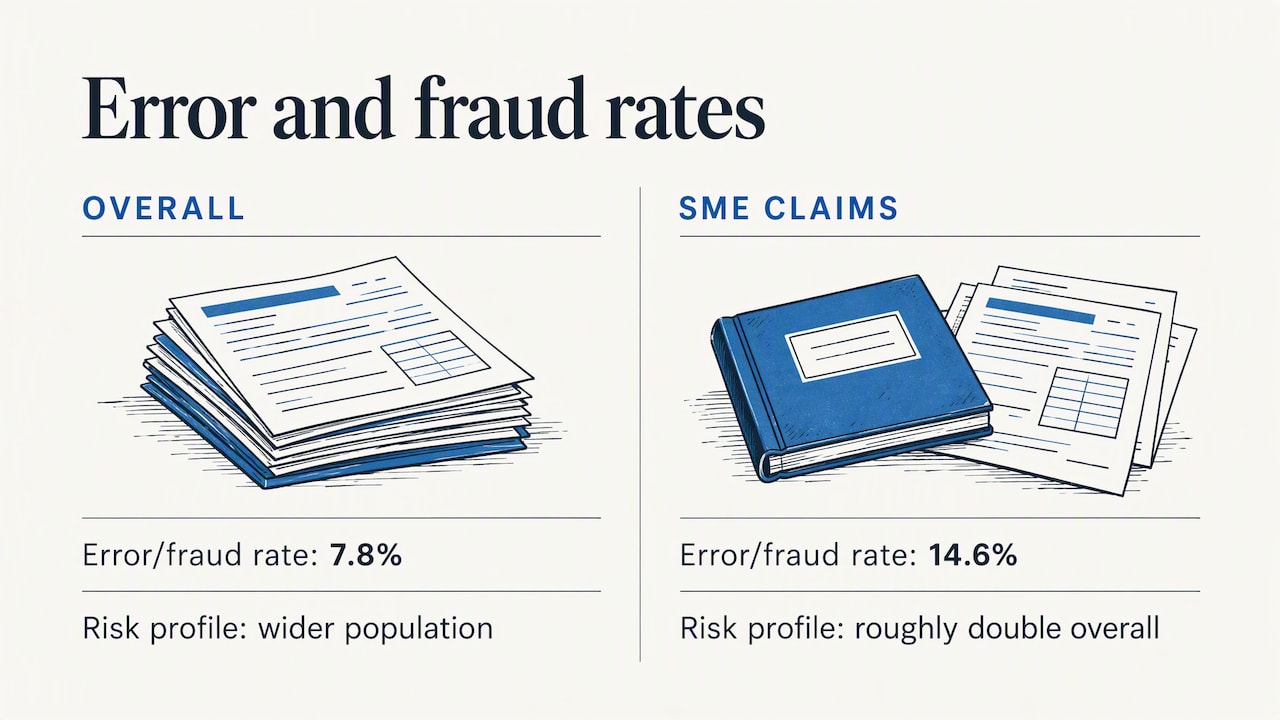
- HMRC estimates error and fraud at 7.8% overall and 14.6% for SME claims; first time claims and sudden spending jumps may attract scrutiny.
- Companies that have not claimed in the previous three accounting periods must notify HMRC within six months after the relevant period ends.
- If no corporation tax is due and no tax credit must be repaid, contact HMRC’s R&D incentives team directly, rather than using its Disclosure Service.
Table of Contents
- 1. The most common errors that cause R&D claims to fail
- 2. What HMRC is seeing now: error, fraud and compliance activity
- 3. Administrative requirements and deadlines that commonly invalidate claims
- 4. Correcting errors: amendment, voluntary disclosure and what to expect
- 5. Prevention: a practical checklist and process controls
- Author perspective from Price & Accountants
- How Price & Accountants can help with claim errors
- FAQ
- Sources
1. The most common errors that cause R&D claims to fail
Most rejected or reduced claims trace back to a handful of recurring mistakes, and most of them are entirely preventable with better process rather than better luck.
- Qualification boundary errors: treating routine software development or standard engineering work as if it resolved genuine scientific or technological uncertainty.
- Staff cost overclaims: apportioning time to R&D based on job title rather than actual hours spent on qualifying activity.
- Ineligible expenditure: including costs such as production, distribution or general management overheads that HMRC does not treat as qualifying.
- Contractor and overseas cost mistakes: misapplying the rules on subcontracted R&D or claiming for work carried out abroad where it no longer qualifies.
- Project-level overclaims: bundling commercially routine work into a technically uncertain project to inflate the claimed spend.
- Templated narratives: submitting generic technical descriptions that could apply to almost any software project, with no project-specific evidence.
Under HMRC review, these errors rarely produce the same outcome. A boundary error on one workstream often leads to partial disallowance of that cost line, while a templated narrative with no supporting evidence can see the whole claim rejected. HMRC would reduce the claim to the supportable proportion, and if the shortfall looks careless rather than innocent, a penalty often follows.
2. What HMRC is seeing now: error, fraud and compliance activity
HMRC has sharpened its scrutiny of R&D claims considerably over the past two years, and the numbers show why. In its approach to R&D tax reliefs for 2023 to 2024, HMRC increased compliance coverage to 17%, settled around 9,700 claims, and identified £441 million in incorrectly claimed relief. The estimated level of error and fraud sits at 7.8% overall, rising to 14.6% for SME claims, which means small and medium companies carry roughly double the risk profile of the wider population.
Much of this activity runs through HMRC’s Mandatory Random Enquiry Programme (MREP), which samples claims regardless of risk flags, alongside a dedicated Anti-Abuse Unit targeting deliberate manipulation and claim farming. Claims that are more likely to draw attention include first-time claims, sudden jumps in claimed spend from one year to the next, and patterns linked to agents whose previous submissions have shown recurring weaknesses.
3. Administrative requirements and deadlines that commonly invalidate claims
Technical eligibility is only half the battle. A perfectly qualifying project can still lose its relief entirely because of a procedural misstep, and these mistakes are among the easiest to prevent once you know the sequence.
- Submit the AIF before or on the same day as the CT600. Since 8 August 2023, the additional information form is mandatory, and submitting the CT600 first removes the claim entirely, with no opportunity to backdate the form.
- Meet the claim notification deadline for first-time or long-gap claimants. Companies that have not claimed in the previous three accounting periods must notify HMRC within six months of the end of the relevant accounting period, including basic company and contact details.
- Respect the statutory amendment window. Claims and amendments generally must be made within two years of the end of the accounting period for most companies, though some periods allow up to 42 months, and HMRC has only limited discretion to accept a late claim.
- Keep accounting dates consistent across the AIF and the CT600. A mismatched period end date between the two filings is a frequent, avoidable cause of HMRC querying or rejecting an otherwise valid claim.
Near an amendment deadline, getting the submission order wrong can permanently close off relief for that period, which is why claim preparation should treat the AIF and CT600 as a single coordinated filing rather than two separate tasks.
4. Correcting errors: amendment, voluntary disclosure and what to expect
Once you have identified an error, the decision tree is fairly simple. If the statutory amendment window for that accounting period is still open, amend the Company Tax Return directly. If it has closed, HMRC’s voluntary disclosure guidance sets out the route through its R&D Disclosure Service, and coming forward early typically results in lower penalties than waiting for HMRC to find the error first. Where there is no Corporation Tax to pay and no tax credit to repay, the Disclosure Service is not the right channel; instead, you contact HMRC’s R&D incentives and reliefs inbox directly with revised computations and an explanation.
A complete disclosure or amendment generally needs:
- Revised computations showing the corrected claim figures.
- A clear explanation of how the error arose and when it was identified.
- An honest assessment of behaviour, since HMRC treats reasonable care, carelessness and deliberate conduct very differently when setting penalties and interest.
Pro Tip: Draft the “how the error arose” explanation before you contact HMRC, not during the call: a clear, consistent account is the single biggest factor in how HMRC assesses behaviour.
Before submitting anything, assemble your ledger entries, payroll records, contemporaneous project notes and a technical sign-off confirming the corrected position. For claims already under active review, our enquiry defence guidance covers how to respond once HMRC has opened a formal check.
5. Prevention: a practical checklist and process controls
Fixing one claim is useful; stopping the same error recurring is what actually protects your relief year after year. A small set of controls, run consistently, covers most of what goes wrong.
- Reconcile monthly, not annually. Allocate staff time to R&D projects from ledger and payroll data each month, rather than estimating retrospectively at year end.
- Document technical uncertainty at project start. Dated notes explaining what was uncertain and why are far more persuasive to HMRC than a narrative written after the work finished.
- Hold a short technical sign-off meeting before submission. A 15-minute review where a technical lead confirms the narrative matches the actual work catches most boundary and overclaim errors.
- Review your agent’s fee structure and evidence base. Ask for detailed time allocation records behind any claim an agent prepares on your behalf, not just the headline figure.
- Calendarise the AIF and notification deadlines with a named owner. A single person should be accountable for confirming the AIF goes in before the CT600, every time.
Pro Tip: Build your claim notification and AIF deadlines into the same calendar you use for Corporation Tax filing, so the same person who tracks one automatically tracks the other.
Our process guide to getting an R&D claim right first time walks through these controls in more detail, and our piece on eligible costs under the current rules is worth reading before you finalise next year’s expenditure categories.
Author perspective from Price & Accountants
Most of the remediation work we see is about evidence, not eligibility: the underlying project often genuinely qualifies, but the paper trail does not support it. Rebuilding contemporaneous notes, reconciling payroll against project time, and getting technical sign-off before resubmission usually turns a shaky claim into a defensible one, and it takes far less management time than fighting an enquiry after the fact.
— Rahamut
How Price & Accountants can help with claim errors
If you suspect your R&D claim has an error, or you want this year’s claim built correctly from the start, professional support is available, not just generic checklists.

- Reviewing and correcting existing R&D claims, including amendments and voluntary disclosure preparation.
- Defending claims under active HMRC enquiry, with full documentation and technical sign-off support.
- Building compliant claims from scratch, including AIF and CT600 coordination and ongoing ledger reconciliation.
Get in touch through our R&D tax credit service page or check our pricing to see which service level fits your business.
This article is general information, not a substitute for advice from a qualified financial advisor. Consult a qualified financial professional about your own circumstances before acting on anything here.
FAQ
What happens if I find an error in my R&D claim?
If the statutory amendment window for that accounting period is still open, you amend the Company Tax Return directly. If it has closed, you use HMRC’s voluntary disclosure service, and coming forward early usually reduces the penalty compared with waiting for HMRC to find it.
How long do I have to amend an R&D tax relief claim?
Amendment windows depend on your accounting period length: broadly two years from the end of the period for most companies, extending to 42 months in some cases, with HMRC retaining only limited discretion to accept a late claim.
Does submitting the CT600 before the AIF invalidate my claim?
Yes. Since 8 August 2023, the additional information form must be submitted before or on the same day as the CT600, and submitting the CT600 first removes the R&D claim entirely for that return.
How common are errors in R&D tax relief claims?
HMRC estimates the overall level of error and fraud in R&D reliefs at 7.8%, rising to 14.6% for SME claims specifically, according to its approach to R&D tax reliefs for 2023 to 2024. That report also covers 9,700 settled claims and £441 million in relief identified as incorrectly claimed.
Can I get professional help correcting a wrong R&D claim?
Yes, specialist accountants can review your existing claim, prepare amendments or voluntary disclosures, and rebuild your supporting evidence. Our R&D tax credit service covers exactly this kind of remediation work for UK companies.